We’ve narrowed the field to three Big Red standouts for 2025 that balance power, performance, and value. We’ll compare a portable 7-gallon tank for quick inflations, an ultra-quiet 6.3-gallon oil-free unit suited to nailers and light spray, and a 26-gallon quiet workhorse for longer runs. We’ll also cover key buying factors—noise, CFM, duty cycle, and portability—so you can match a compressor to your workflow. Let’s see which one earns a spot in your shop next.
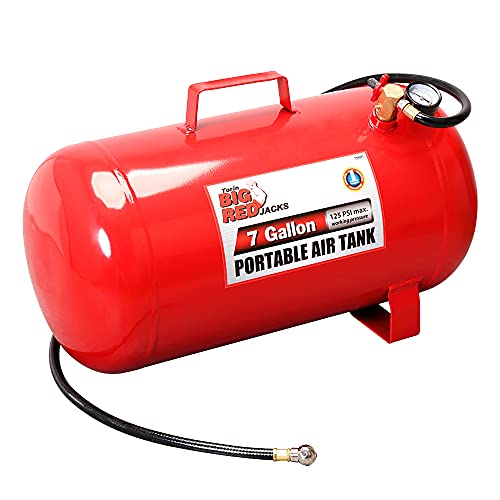
BIG RED Torin Portable Horizontal 7-Gallon Air Tank with 3’6″ Hose

July 11, 2026 9:22 pm
If you need a grab-and-go air source for tires, tools, or quick cleanups, BIG RED’s T88007 7-gallon portable tank stands out for its 125 psi capacity, shut-off fill valve, and easy-to-read gauge. We like its 7-gallon alloy steel build, compact 20.3 x 9.8 x 12.6-inch footprint, and manageable 18.3-pound weight for portability around the garage or property. The 36-inch 1/4-inch NPT hose with tire chuck makes quick inflations easy, while dual safety valves add peace of mind. It holds air for months, though leaving it connected can invite slow leaks. Noise is modest at 65 dB. A 1-year warranty backs it.
Best For: DIYers and homeowners who want a portable, easy-to-use 7-gallon air source for inflating tires, sports gear, and quick blow-cleaning around the garage or property.
Pros:
- 125 psi capacity with shut-off fill valve and easy-to-read gauge for convenient, controlled fills
- Portable alloy steel build at 18.3 lb with compact 20.3 x 9.8 x 12.6-inch size and 36-inch 1/4″ NPT hose with tire chuck
- Dual safety valves (pressure release and bypass with manual override) and holds air for months
Cons:
- Some users report slow pressure loss over time when left connected to inflators
- Valve feel/durability concerns noted by a few users
- 7-gallon capacity and 36-inch hose may be limiting for larger jobs or distant reach
6.3 Gallon Ultra Quiet Oil-Free Air Compressor (2.5HP, 115 PSI)

July 8, 2026 8:45 am
Looking for a portable compressor that stays quiet without skimping on muscle? This 6.3-gallon Ultra Quiet Oil-Free unit hits 75 dBA, making shop talk easy while delivering 2.5HP and 3.2 SCFM at 90 PSI (max 115 PSI). The 1100W motor spins at 3450 RPM, and the oil-free design means low maintenance.
We like the rugged build: Q235B steel with anti-rust coating, bonded powder finish, and seamless welds. A heat-resistant intake (silicone to 392°F with braided stainless sleeve) boosts longevity. Mobility’s simple with the wheel kit and handle. Dual cooling fans, thermal protection, auto shut-off, and pressure relief add safety. Great for nailers, spraying, tire inflation, and light impact work.
Best For: DIYers and pros who need a portable, quiet, low-maintenance compressor for nailers, light impact tasks, spray work, and tire inflation without overwhelming shop noise.
Pros:
- Ultra-quiet 75 dBA operation with oil-free, low-maintenance design
- Solid performance: 2.5HP, 3.2 SCFM @ 90 PSI (max 115 PSI) in a portable 6.3-gallon package
- Durable build (Q235B steel, anti-rust coating, powder finish) with thermal protection, dual cooling fans, and automatic shut-off
Cons:
- Slower recovery for continuous high-volume air tools (e.g., nibblers, sustained grinding)
- 115 PSI max may be limiting for tools requiring higher pressure or airflow
- Heavier than ultra-compact units; still requires wheels/handle for comfortable transport
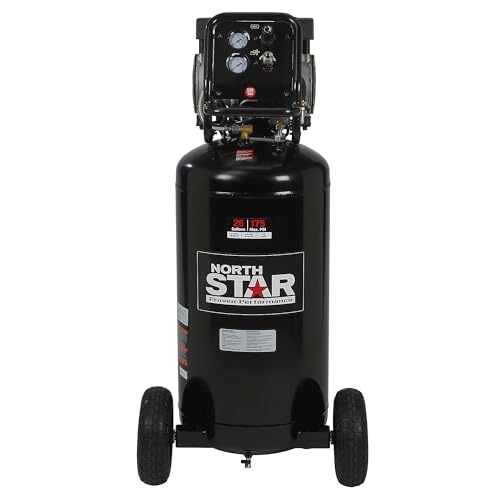
NorthStar Portable Quiet Electric Air Compressor (1.5 HP, 26 Gallons)
July 9, 2026 9:00 pm
Prefer 70 dBA quiet without sacrificing output? NorthStar’s Portable Quiet Electric Air Compressor delivers 4 SCFM at 90 PSI from a 1.5 HP, 26-gallon setup that keeps shop noise low—about 80% quieter than typical 2-gallon, 150 PSI oil-free units. We like how the heavy-duty, direct drive induction motor and oil-free pump combine longevity with zero maintenance.
It’s built to last—up to 4X the life of many 20-gallon compressors—yet remains portable for jobsite moves. Two pressure gauges, a working pressure regulator with its own gauge, and a single coupler keep operation simple. The integrated handle shields the gauge panel, boosting durability.
Best For: Pros need a quiet, low-maintenance, portable compressor that still delivers solid output for shop or jobsite tasks.
Pros:
- 70 dBA operation—about 80% quieter than typical 2-gal., 150 PSI oil-free units, enabling comfortable, extended work sessions
- Durable, heavy-duty direct drive induction motor and oil-free pump for up to 4X the life of many 20-gallon compressors with zero maintenance
- 4 SCFM at 90 PSI from a 1.5 HP, 26-gallon tank balances portability with dependable airflow
Cons:
- Single coupler limits simultaneous tool use without additional manifolds
- Larger 26-gallon size may be bulkier than ultra-compact options for tight spaces
- Not designed for very high-demand, continuous industrial air requirements
Factors to Consider When Choosing Big Red Air Compressors
As we size up Big Red options, we’ll match tank size, max PSI, and CFM to the tools and runtimes you expect. We’ll also weigh noise levels if the compressor will live in a garage, shop, or jobsite with neighbors nearby. Finally, we’ll decide between oil-free for low maintenance or oiled for longevity and smoother operation.
Tank Size Needs
Why does tank size matter so much? Because it dictates how long we can work before the pump kicks back on. A larger tank stores more compressed air, giving us longer runs between cycles and fewer startups, which helps smooth out pressure dips during steady work.
We should match tank capacity to the average SCFM draw of our tools. If we mainly use intermittent tools, a 7-gallon tank—like the Big Red 7-Gallon—hits a sweet spot: portable, yet with an extended air reserve. For high-demand tasks, lower volumes (around 6–8 gallons) will cycle more often and create more runtime gaps.
If we expect continuous or heavy use, a higher-capacity tank maintains consistent pressure longer. The trade-off: extra bulk and weight that affects transport.
Max PSI Rating
Tank capacity sets how long we can work; max PSI sets how hard the system can push. The max PSI rating tells us the maximum pressure the tank can safely hold and deliver to our tools. Go higher, and we gain faster inflations and compatibility with pressure-hungry tools—but we also need robust safety features and disciplined use.
For most portable jobs, Big Red tanks around 125 PSI hit a smart balance: enough headroom for standard tire inflation and general tasks without extra bulk. We must stay within the rated limit to prevent over-pressurization and tripping the safety valve.
CFM Requirements
How much air do our tools really need? CFM tells us. We match Big Red models to tools that require steady airflow—think nail guns, spray guns, or die grinders—at a specific PSI. We look for the stated SCFM at our target PSI (for many tools, 90 PSI). If a compressor lists 3.2 CFM @ 90 PSI, it should sustain that output for continuous operation.
Higher CFM at the same PSI lets us run multiple tools or high-demand tools without a pressure dip. With 6.3-gallon tanks and larger, the initial CFM rating also shapes startup snap and recovery after bursts. We compare CFM across models to balance portability (smaller tanks) against runtime. Pick the CFM that matches our heaviest task, then size the tank to our workflow.
Noise Levels
Curiously, noise can make or break our day with a compressor. Big Red models span roughly 65–75 dB, and that 10 dB gap matters. Around 65 dB, we can hold a conversation and work longer with less fatigue; around 75 dB, we’ll likely raise our voices and tire sooner. We should check the listed dBA or dB ratings to match our tolerance and workspace needs.
Oil-Free Vs Oiled
When should we choose oil-free over oiled, and vice versa? We look at the job and duty cycle. Oil-free compressors use pumps that don’t need lubrication, so maintenance drops and there’s no risk of oil drifting into the air stream. That cleaner output is ideal for painting, finishing, and hobby work, where residue ruins results. Oil-free designs also use heat-tolerant materials and often run lighter and quieter.
However, under high-volume or continuous workloads, oil-free units can wear faster and need more frequent service. Oiled compressors, with crankcase lubrication, handle heavy, sustained use better and can deliver longer pump life in demanding applications. If we’re running tools all day, oiled makes sense. For clean air, simple upkeep, and intermittent tasks, oil-free is the smarter pick.
Portability Features
Looking to move air where the work is? Let’s prioritize portability. A smart design lets us roll or carry a compressor without strain. Horizontal 7-gallon tanks with integrated wheels and grab handles move smoothly between bays and job sites. We watch weight-to-capacity balance: a 7-gallon tank around 18.3 lb relocates far easier than bulky stationary units while still covering common tasks.
Transport-friendly fittings matter. Built-in shut-off valves and quick-disconnects let us fill, detach, and store without bleeding the tank. Hose length helps too—a 36-inch line reaches tight corners without dragging the unit. Compact dimensions—roughly 20.3 x 9.8 x 12.6 inches on some tanks—clear shelves and doorways. Finally, integrated safety features and basic gauges streamline on-site checks, keeping portability both practical and safe.
Build Materials
Portability only pays off if the compressor’s built to handle knocks and pressure. That’s why we look closely at build materials. Big Red’s alloy steel tanks deliver a tough, corrosion-resistant shell that stands up to jobsite abuse and weather. The tanks are engineered for maximum operating pressures up to 125 psi, signaling a robust internal structure that won’t fatigue under routine cycling.
We also value the rigid frame. It keeps the unit stable in transit while staying relatively lightweight for its capacity, which matters when we’re hauling gear across a site. On the 7-gallon model, the 36-inch hose and 1/4 inch NPT connector add reach and compatibility without bulk. Together, these material choices balance durability, portability, and everyday usability in the field.
Safety Mechanisms
How do we judge a compressor’s safety without guesswork? We look for layered protection. Big Red builds in a pressure release valve and a safety pressure bypass valve with a manual override, so overpressure events are relieved before they become hazards—and we can intervene if needed. A shut-off valve on the input lets us fill and disconnect without draining the tank, preventing accidental pressure loss and messy resets during setup.
We also want pressure integrity while delivering air. These systems maintain stable pressure to hoses and gauges, reducing surprises at the tool end. Noise control and thermal protection add indirect safety by cutting fatigue and guarding against overheating on long runs. Together, these mechanisms create predictable, controlled operation when tank pressures run high.
Conclusion
We’ve highlighted three standout Big Red options that hit the sweet spot of power, performance, and value. The 7-gallon tank nails portability and quick jobs, the 6.3-gallon ultra-quiet unit keeps noise down while delivering reliable CFM, and the NorthStar 26-gallon steps up for sustained tasks. If we match capacity, noise, and airflow to our needs—and consider duty cycle, portability, and maintenance—we’ll pick confidently and work smarter, whether we’re inflating, nailing, or tackling longer shop projects.