When we’re pushing nailers, sanders, or spray guns all day, CFM—not just PSI—makes or breaks productivity. In 2025, a few compressors stand out for sustained airflow, durability, and manageable noise, from shop-sized 60–80 gallon units to portable worksite performers. We’ll compare real CFM at 90 PSI, duty cycles, pump types, and maintenance needs, and flag which models truly run continuous tools without bogging down. Let’s start with the contenders that actually keep up.
Metabo HPT Pancake Air Compressor (EC711S)


July 13, 2026 9:15 pm
If you want dependable nail-gun power without the bulk, the Metabo HPT Pancake Air Compressor (EC711S) stands out with 2.8 CFM at 90 PSI, a 165 PSI max, and a quick 46-second tank recovery—ideal for brad and finish nailing on fast-paced jobs. We like its 6-gallon tank, 1 HP motor, and oil-free design that starts reliably in cold weather and needs minimal maintenance. At 73 dB and 38.5 lbs, it’s manageable on sites. The steel tool cage, rubber grip, and two 1/4 universal quick couplers speed setup. Add optional splitters and hoses to expand capacity. Backed by a 1-year professional warranty.
Best For: Professionals and DIYers who need a portable, low-maintenance pancake compressor with quick recovery for brad and finish nailing and other nail-gun tasks.
Pros:
- Strong performance for size: 2.8 CFM at 90 PSI, 165 PSI max, with a fast 46-second tank recovery
- Oil-free, 1 HP motor starts reliably in cold weather and requires minimal maintenance
- Portable and durable: 6-gallon tank at 38.5 lbs with steel tool cage, rubber grip, and dual 1/4 universal quick couplers
Cons:
- 73 dB noise level may be noticeable in quiet environments
- Limited to light-to-medium duty air demands; not ideal for high-draw tools
- Some variability in noise reported by users across units
13 Gallon Ultra Quiet Oil-Free Air Compressor (2HP, 115 PSI, 75 dBA)

July 8, 2026 10:50 pm
Serious DIYers and light-duty pros who want quiet, steady airflow without oil hassles will appreciate VELPAX’s 13-gallon Ultra Quiet Oil-Free Air Compressor. We get 4.2 SCFM at 90 PSI, a 115 PSI max, and a 1500W, 3450 RPM motor that stays civilized at 75 dBA. Dual cylinders and dual intake tubes help it recover quickly.
Durability impresses: a 3-layer Q235B steel tank with anti-rust coating, bonded powder finish, and seamless welds. The intake system uses high-temp silicone (to 392°F) with a braided stainless sleeve. Safety includes thermal protection, dual cooling fans, auto shut-off, and pressure relief. It’s portable, tool-ready, and oil-free, with mixed reviews and a 30-day return window.
Best For: Serious DIYers and light-duty pros who need a quiet, portable, oil-free compressor that delivers steady airflow for common pneumatic tools and shop tasks.
Pros:
- Quiet operation at 75 dBA with 4.2 SCFM @ 90 PSI for reliable tool performance
- Durable 3-layer Q235B steel tank with anti-rust coating, powder finish, and seamless welds
- Safety-focused design: thermal protection, dual cooling fans, auto shut-off, and pressure relief
Cons:
- Max pressure capped at 115 PSI, limiting some higher-pressure applications
- Mixed customer reviews; only a 30-day return window noted
- Heavier 13-gallon unit—portable with wheels/handle but not as easy to tote as smaller tanks
ALL-TOP 12V Air Compressor with LCD Control Panel (Dual Cylinder)

July 7, 2026 3:39 pm
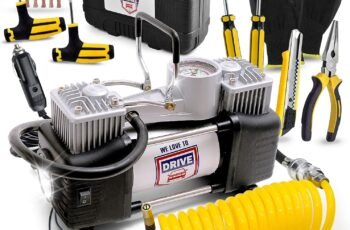
Built for overlanders and big-tire rigs, the ALL-TOP 12V Dual Cylinder with LCD control stands out for its 12.35 CFM airflow and auto-stop preset pressure—exactly what we want when fast, repeatable fills matter. It hits 150 PSI, supports PSI/BAR/KPA/kg/cm², and pairs a heavy-duty motor with dual cylinders on an anti-vibration metal base. We like the cleanable filter, insulated handle, and battery clamps, plus mount-or-carry flexibility.
In testing, it aired 315/70R17s from 10–25 PSI in 1 minute (to 31 PSI in 1:15) with the engine running. It’s loud, the inline gauge can wander while pumping, and safety cutoffs exist—but don’t leave it unattended.
Best For: Overlanders and off-road drivers with large tires who need fast, repeatable inflations and a rugged, mountable 12V compressor with auto-stop and LCD controls.
Pros:
- High airflow (12.35 CFM) and dual cylinders deliver rapid fills; real-world test: 315/70R17 from 10–25 PSI in ~1 minute.
- LCD with preset target pressure and auto-stop; supports PSI/BAR/KPA/kg/cm².
- Heavy-duty build with anti-vibration base, thermal/circuit protection, cleanable filter, and included carry bag.
Cons:
- Loud operation; inline gauge can read inconsistently while pumping.
- Reports vary on auto shut-off behavior at max pressure; shouldn’t be left unattended.
- Heavy and bulky (26.4 lbs), requires direct 12V battery clamps and draws high current.
California Air Tools 10020CAD Ultra Quiet Oil-Free Air Compressor (10 Gallon)

July 12, 2026 8:44 pm
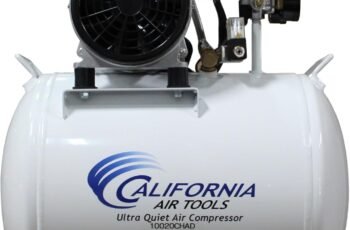
Looking for ultra-quiet power without sacrificing usable airflow? We like the California Air Tools 10020CAD for its 70 dB noise rating, 2.0 HP motor at 1680 RPM, and steady output: 6.4 CFM at 40 PSI and 5.3 CFM at 90 PSI. Its oil-free dual piston pump is rated for 3,000+ hours, delivering cleaner air and low maintenance. The 10-gallon steel tank, wheels, and Easy Start Valve make it practical in shops and garages. Auto Drain Valve helps prevent rust; two gauges and push-to-connect fittings streamline setups. At 125 PSI max, 110V/14A, and 82.5 pounds, it’s portable, reliable, and impressively quiet.
Best For: Users who need a portable, ultra-quiet 10-gallon compressor with reliable airflow for shops, garages, and jobsites without the mess and maintenance of oil.
Pros:
- Ultra quiet at 70 dB with a 2.0 HP, 1680 RPM motor for low wear and smoother operation
- Strong airflow for the size: 6.4 CFM @ 40 PSI and 5.3 CFM @ 90 PSI with stable pressure and easy push-to-connect fittings
- Oil-free dual piston pump rated 3,000+ hours plus Auto Drain Valve for cleaner air and reduced maintenance/rust
Cons:
- Max pressure capped at 125 PSI, limiting some high-pressure pneumatic tools
- Weighs 82.5 lb; portable with wheels but still heavy to lift
- Auto drain vent hose can be loud; may require routing outside or modification for quieter purging
14 Gallon Ultra Quiet Oil-Free Air Compressor (2HP, 115 PSI)

July 13, 2026 7:02 pm
Quiet power stands out here: the Nessxa 14-gallon Ultra Quiet Oil-Free Air Compressor delivers 8.75 CFM at up to 115 PSI while keeping noise to a manageable 70 dB, making it a smart pick for home garages and small shops that need real airflow without the racket. We like its 2HP oil-free motor on 110V, dual quick couplers, and fast ~60-second tank fill thanks to double-cylinder intake. Portability’s solid—wheels, handle, and 59.9 lb weight. The Q235B steel tank and anti-rust finish add durability, while dual cooling fans, auto shutoff, and 70 PSI restart boost safety. It’s reliable for tires, light tools, and airbrushing.
Best For: Home garages and small shops needing quiet, fast-filling airflow for tire inflation, airbrushing, and light pneumatic tools without 240V power.
Pros:
- Ultra-quiet 70 dB operation with dual silencers and oil-free 2HP motor (110V)
- Strong performance: 8.75 CFM up to 115 PSI; ~60-second tank fill; dual quick couplers
- Portable and durable: 59.9 lb with wheels/handle; Q235B steel tank, anti-rust finish, dual cooling fans, auto shutoff/restart
Cons:
- 115 PSI max and ~50% duty cycle may limit heavy continuous tool use
- Heavier and bulkier than small pancake/3–6 gal units for tight spaces
- Warranty details not clearly stated; may require request for specifics
DEWALT 60 Gallon Vertical Air Compressor, 5 HP (Single Stage, 240V)

July 13, 2026 6:34 pm
Delivering 14.6 CFM at 90 PSI and up to 175 PSI from a 5 HP, 240V single-stage motor, DEWALT’s 60-gallon vertical compressor suits serious DIYers and small shops that need consistent, high-volume air without stepping into two-stage territory. We like its 17 CFM at 40 PSI for rapid recovery and the ASME-certified 60-gallon tank that stabilizes pressure during extended runs. The oil-lubed pump and heavy-duty induction motor enhance longevity and smooth output while keeping noise around 70 dB. It’s compact for its capacity, integrates easily, and powers grinders, sanders, and sprayers. Note the 240V requirement. Warranty: 2-year pump, 1-year parts.
Best For: Serious DIYers and small professional shops needing consistent, high-volume air at 240V without moving to a two-stage compressor.
Pros:
- Strong airflow: 14.6 CFM at 90 PSI (17 CFM at 40 PSI) with 175 PSI max for demanding pneumatic tools
- Durable, quiet operation: oil-lubed pump and heavy-duty induction motor around 70 dB with ASME-certified 60-gallon tank
- Space-saving vertical design with reliable DEWALT build and 2-year pump/1-year parts warranty
Cons:
- Requires 240V power and proper wiring (208–230V motor, recommended 240V)
- Single-stage design may not match duty cycle/efficiency of two-stage units for continuous heavy industrial use
- Heavy (222 lbs) and large; installation and shipping can be cumbersome, with occasional motor/shipping issues reported
VEVOR 13-Gallon Oil-Free Air Compressor (2HP, 125 PSI)

July 13, 2026 8:38 am
Need a portable, low‑maintenance unit that still feeds most light-to-medium air tools? We like VEVOR’s 13‑Gallon Oil‑Free (2 HP) for its quiet 66 dB operation, quick build to 125 PSI in under three minutes, and practical output: 4.6 SCFM at 90 PSI (about 3.6 CFM nominal). It’s enough for tire inflation, brad nailers, small spray jobs, and DIY auto and wood tasks.
The reinforced, leak‑proof valve system keeps output steady, while two 7‑inch rubber wheels and a 71‑lb frame roll easily indoors or out. You get filters, gauges, pads, and hardware in the box. Users praise the low noise and value; occasional valve/shipping hiccups appear. Warranty via VEVOR support.
Best For: DIYers and homeowners who need a quiet, portable, low‑maintenance compressor for tire inflation, brad/finish nailers, small spray jobs, and light auto/woodworking tasks.
Pros:
- Quiet 66 dB operation with fast build to 125 PSI in under 3 minutes
- Practical output for light-to-medium tools: 4.6 SCFM @ 90 PSI (approx. 3.6 CFM nominal)
- Oil‑free, low maintenance design with reinforced valve system and easy‑rolling 7″ wheels
Cons:
- Not sufficient for high‑CFM, continuous‑duty pneumatic tools
- Occasional reports of valve part issues and shipping delays
- 71 lb weight may be heavy to lift despite wheels
Quiet 8-Gallon Oil-Free Air Compressor (68dB, 1.2 HP)

July 11, 2026 9:02 am
Looking for low-noise power we can actually use indoors? Limodot’s LJ8120 delivers at just 68 dB. The 1.2 HP, 110V oil-free motor feeds an 8-gallon steel tank to 120 psi, pushing 4.0 CFM at 40 psi and 2.8 CFM at 90 psi—enough for nailers, airbrushes, blow guns, HVLP, and light drills. We like the 30-second recovery and roughly 120-second fill from empty.
At 43.5 pounds with a wheel kit, it’s portable yet stable. Automatic shut-off, maintenance-free operation, and reliable cold starts make it ideal for garages, trim work, and indoor jobs. Reviews (4.5/5, 1,173 ratings) back its quiet, dependable performance.
Best For: Homeowners and pros who need a quiet, portable, oil-free compressor for indoor trim work, nailing, detailing, and general workshop tasks without disturbing the space.
Pros:
- Quiet 68 dB operation suitable for indoor use
- Solid performance for size: 4.0 CFM @ 40 psi and up to 2.8 CFM @ 90 psi with fast recovery (~30s)
- Oil-free, maintenance-free design with reliable cold starts and automatic shut-off
Cons:
- Max pressure capped at 120 psi and CFM limits make it unsuitable for heavy-duty, continuous air tools
- Steel 8-gallon tank adds weight (43.5 lbs); more cumbersome than aluminum counterparts
- 110V-only; not designed for high-demand shop setups or 240V environments
Contractor 4 Gallon Gas Air Compressor with Kohler SH270 Engine

July 8, 2026 7:42 am
For crews who want gas-powered mobility without the racket, the Industrial Air Contractor 4 Gallon with a 196cc Kohler SH270 stands out for its 55 dB quiet operation and oil‑free, low‑maintenance design. We like its direct-drive, oil-free pump, two-pontoon 2-gallon tanks (4 gallons total), and 155 PSI max pressure for punchy, portable performance. The Kohler SH270 starts easily and holds steady output for framing, roofing, and trim. A 2-piece cooling system boosts durability, while cushioned handles and compact 24 x 23 x 22-inch framing simplify transport. At 86.8 pounds, it’s stable yet manageable. Pros get a manufacturer’s warranty and 30-day return window.
Best For: Professional contractors and serious DIYers who need a portable, gas-powered air compressor with quiet 55 dB operation and low-maintenance, oil-free reliability for framing, roofing, and trim work.
Pros:
- 55 dB quiet operation suitable for noise-sensitive jobsites
- Oil-free, direct-drive pump with 2-piece cooling system for low maintenance and durability
- 155 PSI max with dual 2-gallon pontoon tanks for stable, portable performance
Cons:
- 86.8 lb weight can be cumbersome for solo transport
- Mixed customer reviews and mid-tier best-seller ranking
- Gas engine requires fuel management and is not suitable for indoor, unventilated spaces
MZB 13 Gallon Ultra Quiet Oil-Free Air Compressor with Wheels (115 PSI, 110V/60Hz)

July 14, 2026 2:04 am
Serious DIYers and small-shop pros who want high airflow without the racket will appreciate the MZB 13 Gallon Ultra Quiet Oil-Free Air Compressor, delivering up to 14.83 CFM at a max 115 PSI while holding noise to 72 dB. We like its 110V/60Hz twin 1.5HP motors spinning at 2280 r/min and the 13.2-gallon steel tank that fills in about 60 seconds. It’s oil-free, clean, and low-maintenance. The wheeled, three-layer Q235B steel build adds durability and safety with corrosion resistance and low leak risk. It powers staple and nail guns, HVLP spray, air drills, and blow guns across shops and garages.
Best For: Serious DIYers and small-shop pros needing high airflow with low noise for tools like nailers, HVLP spray guns, and air drills in garages or small workshops.
Pros:
- High output for its class: up to 14.83 CFM at max 115 PSI supports multiple pneumatic tools
- Ultra-quiet operation at 72 dB with oil-free twin 1.5HP motors for clean, low-maintenance use
- Durable 13.2-gallon Q235B steel tank with three-layer corrosion-resistant build and wheels for portability
Cons:
- 115 PSI max may be limiting for tools that require higher pressure
- Larger footprint and weight than small pancake/portable compressors
- 110V/60Hz operation may restrict use where 220V high-demand setups are preferred
Factors to Consider When Choosing High CFM Compressors
As we pick a high-CFM compressor, we should match required CFM and PSI to our tools, check the duty cycle, and keep noise level (dB) acceptable for the workspace. We’ll also balance tank size needs for task duration and portability. Finally, we must confirm power source compatibility—120V vs. 240V, single- vs. three-phase—to ensure reliable start-up and performance.
Required CFM and PSI
Wondering how much air you actually need? Let’s pin down CFM and PSI so we size a compressor that won’t choke under load. CFM tells us how much air the pump delivers at a specific pressure—think specs like 4.2 SCFM at 90 PSI or 6.4 CFM at 40 PSI. Match your most demanding tool’s required CFM at its operating PSI to the compressor’s rated CFM at that same PSI.
PSI sets the ceiling for pressure and influences how quickly the system recovers. Many high-CFM units top out between 115–175 PSI, which expands tool compatibility and helps maintain pressure during bursts.
For smooth operation—especially with air-hungry tools like framing nailers or spray systems—choose higher CFM at your target PSI, and consider larger tanks to shorten recovery after sustained use.
Duty Cycle Rating
We’ve matched CFM and PSI; now we need to keep that airflow coming without cooking the compressor. Duty cycle tells us how long a unit can run at full load within 60 minutes—say 50% means 30 minutes on, 30 off. High CFM demands shrink practical duty cycle because the pump runs longer to hold pressure.
We should check whether the rating is specified at 40 PSI or 90 PSI; some models list different duty cycles by pressure. Dual-cylinder pumps and larger tanks help by recovering faster, giving the motor more rest between high-demand bursts.
Most important, we must match our workflow to the rated duty cycle. Exceed it and we risk overheating, tripped protection, and shortened life. For near-continuous use, target higher duty-cycle designs.
Noise Level (Db)
How loud will a high‑CFM compressor be in your space? Noise level, measured in decibels (dB), tells us how intrusive operation will feel. Quiet models typically run around 66–75 dB—manageable for garages and shared spaces—while larger industrial units often push past 70–80 dB.
With high CFM, there’s usually a tradeoff: more airflow can mean more noise. Still, some compressors counter this with dual cooling, better isolation, or mufflers, delivering higher output while holding dB in check. Ultra‑quiet options emphasize 66–70 dB ratings to reduce fatigue and conversation disruption.
When comparing models, we look at the stated dB and where we’ll use the machine. Indoors or near others, aim lower. Outdoors or in open shops, slightly higher dB may be acceptable for the added performance.
Tank Size Needs
Keeping noise in check is only half the equation; the tank has to sustain the airflow your tools demand. Larger tanks store more air, letting us run high-CFM tools longer between refills and reducing pressure dips during heavy bursts. While higher CFM at the required PSI often comes with a bigger tank, we should match both to our tool’s airflow profile for steady performance.
For many jobs, 8–14 gallon tanks strike a smart balance: portable enough to move, yet with ample reserve for intermittent high-CFM work. Tank size also affects recovery. Bigger tanks recover faster after bursts because they hold more air to stabilize pressure.
If we need a steady high CFM stream, look for 6–13 gallon tanks paired with a high-output pump to limit depressurization.
Power Source Compatibility
While CFM and PSI set the performance stage, power source compatibility decides where and how we can actually use that airflow. We should match the compressor to our power access and duty cycle. Electric high-CFM models run on 110V–240V; we need to confirm voltage and phase, plus adequate circuit protection, to avoid nuisance trips under heavy draw. Manufacturers list CFM at 90 PSI and 40 PSI, which helps us gauge sustained airflow with dual-stage pumps.
Gas-powered units suit sites without reliable electricity. They typically pair larger tanks with lower idle noise to keep CFM steady during long runs. Beyond power type, pump design and tank size influence recovery and continuous output—oil-lubed pumps often favor longevity and smoother delivery, while oil-free designs simplify maintenance.
Portability and Weight
Power access sets the stage, but portability and weight determine whether we can actually bring that airflow to the work. If we’re hopping job to job, pancake-style 6-gallon and compact 8–14 gallon units shine; at roughly 38–60 lb with built-in handles, they’re easy to load, roll, and stash. Wheel kits and carrying grips further ease moves across gravel, stairs, or a tight shop.
Heavier options—think 60-gallon stationary or 82+ lb portables—deliver longer run times, but they’re painful to shuttle and better suited to a fixed bay. Higher-CFM output often rides on larger tanks and dual cylinders, which add bulk and reduce agility. Gas-powered contractor models add noise and weight, trading transportability for muscle. We should match mobility to our job cadence and workspace.
Maintenance and Warranty
A smart maintenance and warranty plan saves money and downtime with high-CFM compressors. We prioritize designs that cut upkeep and protect our investment. Oil-free compressors reduce routine service and eliminate the risk of oil contaminating nailers, sprayers, and CNC air circuits. We also verify built-in safeguards: automatic shut-off and thermal protection prevent overheating, extending component life.
Warranty terms matter. We compare coverage length and scope—full parts-and-labor for a year (or more) beats vague “limited” language. Tank size and recovery time influence wear; a larger tank and faster recovery can lower duty cycles and reduce service frequency under heavy shop use. Finally, we read user reliability reports and confirm parts availability and responsive support, which often predict real-world warranty performance.
Conclusion
We’ve walked through standout high-CFM options for every job, from ultra-quiet shop units to portable powerhouses. Now it’s about matching CFM and duty cycle to your tools, picking the tank size that keeps pressure steady, and weighing noise, portability, and maintenance. When in doubt, go a little higher on CFM for headroom. With the right compressor, we’ll spray smoother, drive faster, and work longer—reliably. Let’s choose smart, stay safe, and keep the air flowing.