As shop demands grow in 2025, we need air compressors that deliver steady CFM, dependable duty cycles, and manageable noise without constant maintenance. We’ll compare compact 20-gallon workhorses and serious rotary screws, weigh oil-free versus oil-lubed pumps, and highlight mobility and build quality. From tire work to spray jobs, the right unit saves time and protects tools. Let’s see which five models actually meet the specs shops rely on every day.
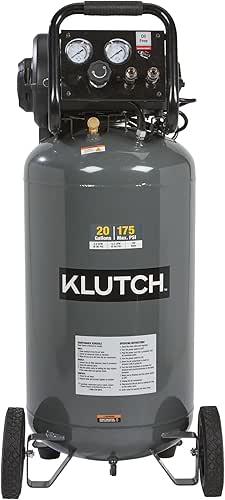
Klutch 20-Gallon Air Compressor, 2 HP, 120 Volts, 175 PSI

March 8, 2026 5:33 am
Need a portable, low‑maintenance workhorse for tire service, light impact tools, and quick fill-ups? We like the Klutch 20-Gallon Air Compressor for its 2 HP motor, 120V plug-and-play convenience, and stout 175 PSI max. It delivers 4.2 SCFM at 90 PSI (5.2 CFM max), giving quick recovery for shop tasks. The oil-free pump cuts upkeep, while thermal overload protection and rubber foot stabilizers boost reliability. At 90 pounds with large wheels and an ergonomic handle, it’s easy to move. Noise is a manageable 80 dB. Users rate it 4.2/5, noting quick fills; occasional leaks were solved by tightening fittings. 30-day returns apply.
Best For: DIYers and pros who need a portable, low‑maintenance compressor for tire service, nailers, and light impact tools with fast recovery and 120V convenience.
Pros:
- 175 PSI max with 4.2 SCFM @ 90 PSI (5.2 CFM max) for quick recovery and versatile shop tasks
- Oil‑free pump, thermal overload protection, and rubber foot stabilizers for low maintenance and reliability
- Portable 20-gallon design with large wheels, ergonomic handle, and manageable 80 dB noise level
Cons:
- 90 lb weight can still be cumbersome on stairs or uneven terrain
- Occasional reports of air leaks or shipping damage; may require tightening fittings or exchanges
- Not ideal for continuous heavy air demand (e.g., large sanders or grinders) due to CFM limits
California Air Tools 20-Gallon Ultra Quiet Oil-Free Air Compressor (CAT-20015)

March 1, 2026 4:15 pm
For shops that prize quiet, low-maintenance air on a 110V circuit, the California Air Tools CAT-20015 stands out with 70 dB operation and an oil-free dual-piston pump rated for 3,000+ hours. We get a 1.5 HP, 1750 RPM motor, 20-gallon steel tank, and 135 PSI max—solid for general automotive tasks. Output is 2.9 CFM at 90 PSI (4.0 at 40), enough for brad nailers, blow-off, tire work, and light spraying; it’s modest for continuous sanders or high-flow spray guns. Dual gauges, two push-to-connect outlets, and cold-start reliability help daily use. At 89 pounds, the vertical design, handle, and no-flat wheels keep it portable.
Best For: Quiet-focused home garages and small shops needing a 110V, low-maintenance compressor for general tasks like nailing, blow-off, tire inflation, and light spraying.
Pros:
- Ultra-quiet 70 dB operation with oil-free dual-piston pump rated 3,000+ hours for low maintenance
- 20-gallon vertical tank, 135 PSI max, and 2.9 CFM @ 90 PSI suitable for many DIY and light shop tasks
- Portable design with handle and no-flat wheels; dual gauges and two push-to-connect outlets for easy use
Cons:
- Airflow is modest for continuous-duty tools like sanders or high-flow spray guns
- 89 lb weight still hefty to load into vehicles despite wheels
- 110V, 1.5 HP setup limits recovery speed compared to larger 240V units
DV-10A Rotary Screw Air Compressor, 10HP 460V 3-Phase, 125 PSI 35 CFM

July 8, 2026 7:42 am
Looking to outfit a busy bay with steady air and low maintenance? The DV-10A Rotary Screw Air Compressor delivers 10HP performance at 460V/3-phase with a service factor of 1.15 for short bursts. We get up to 125 PSI and a steady 33 CFM through a 3/4” NPT outlet—ideal for impact tools, paint prep, and tire work. The IP54-rated motor resists dust and splashes, while Class B temperature rise ensures thermal reliability. We appreciate the external combination valve and easy maintenance design that cut downtime. It’s a smart fit for car repair shops, small fabrication and machining, car washes, and light manufacturing.
Best For: Busy automotive bays, small fabrication/machining shops, car washes, and light manufacturing that need steady 33 CFM at 125 PSI with low-maintenance 10HP performance on 460V/3-phase power.
Pros:
- Steady 33 CFM at 125 PSI through 3/4″ NPT outlet supports impact tools, paint prep, and tire work
- IP54 motor rating and Class B temperature rise enhance durability and thermal reliability
- External combination valve and easy maintenance design reduce downtime
Cons:
- Requires 460V 3-phase power, which may not be available in all facilities
- 33 CFM output may be insufficient for larger shops or high-demand multi-tool setups
- Rotary screw compressors typically have higher upfront cost than small reciprocating units
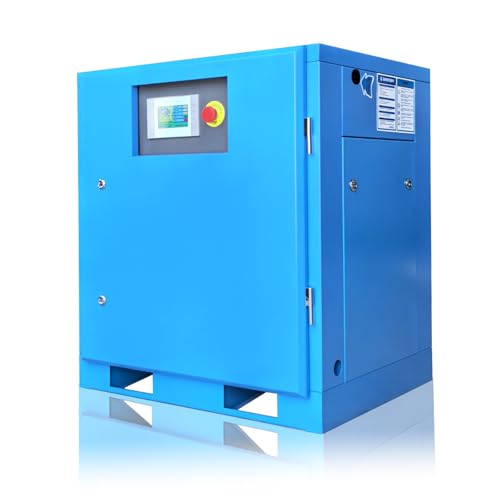
460V 10HP Variable Speed Rotary Screw Air Compressor (3-Phase, 39 CFM, 120 PSI)
July 11, 2026 4:36 pm
Serious shops that want stable air at lower energy costs will appreciate Bilowk’s 10HP variable-speed rotary screw (460V, 3‑phase) delivering 39 CFM at up to 120 PSI. We like its inverter drive: soft starts, real-time speed control, steady pressure, and lower noise at 70 dB. It’s compact (2.95L x 24.4W x 31.4H), 326 pounds, cast iron, with a 3/4″ NPT outlet and 3600 rpm motor. Installation’s simple—pre‑debugged; connect power and air and go. Plan annual filter and oil changes. Keep it indoors or cover outdoors. It’s ideal for nailing, sanding, air brushing, and continuous-duty shop tasks. Three‑phase only—no converters.
Best For: Commercial and industrial shops with 460V three‑phase power that need steady, energy‑efficient continuous air (39 CFM, up to 120 PSI) for tools and production lines.
Pros:
- Variable-speed inverter drive for soft starts, stable pressure, lower noise (≈70 dB), and energy savings
- Compact footprint with 3/4″ NPT outlet; simple install—pre‑configured, just connect power and air
- Durable cast-iron build; suitable for continuous-duty applications across many industries
Cons:
- Requires 460V three-phase power; not compatible with single-phase or phase converters
- Annual maintenance needed (filters and oil changes)
- Moderate weight (326 lbs) and indoor placement preferred or weather protection required outdoors
ECCPP A/C Compressor with Clutch for GMC Terrain/Chevy Equinox 2.4L (2012–2015)

July 14, 2026 5:04 pm
Need a direct-fit, pre-oiled replacement for a 2012–2015 GMC Terrain or Chevy Equinox 2.4L? We like ECCPP’s A/C Compressor with Clutch: a 7SBH17C unit with a 5-groove, 120 mm pulley, aluminum housing, and PAG46 oil pre-filled at 130 ml. It’s tested, nitrogen pressure-checked, and built to meet or exceed OE. Compatible part numbers include 4472604820, TEM276463, 4472604850, 22798745, and 5512943.
For shops, it installs cleanly and ships ready to run—don’t add oil initially; excess oil can cause failure. Weight is 14.83 lb; package: 10.83 x 9.37 x 7.56 in. Expect quiet operation, but note mixed durability reviews. Warranty details live on Amazon.
Best For: Owners or shops needing a direct-fit, pre-oiled replacement A/C compressor with clutch for 2012–2015 GMC Terrain or Chevy Equinox 2.4L engines.
Pros:
- Pre-filled with PAG46 (130 ml) and ships ready to install; no initial oil add needed
- Direct-fit 7SBH17C with 5-groove, 120 mm pulley; matches multiple OEM part numbers (e.g., 4472604820, 22798745)
- Factory-tested and nitrogen leak-checked; designed to meet or exceed OE standards
Cons:
- Mixed durability reviews suggest potential longevity concerns
- Overfilling oil can cause failure, requiring careful adherence to system specs
- Warranty details are not fully transparent in-box; must check Amazon product page
Factors to Consider When Choosing Air Compressors for an Automotive Shop
Let’s match compressor specs to the work we actually do by confirming required CFM and PSI, ensuring a duty cycle that survives continuous use, and choosing a tank size that buffers peak demand. We’ll also check available power and voltage so the unit starts reliably on our circuit. Finally, we’ll account for noise constraints to keep the shop productive and compliant with local limits.
Required CFM and PSI
How do we size air correctly so tools don’t stall or starve? We start with CFM and PSI at the tool’s operating pressure. CFM tells us how much air the compressor delivers at, say, 90 PSI; we match or exceed the tool’s required CFM so it runs without sag. PSI indicates the maximum pressure the system can build and maintain. Many shop tools live between 90–175 PSI, but pressure alone isn’t performance—delivering the needed CFM at that PSI is.
We size to our most demanding tool: match its required CFM at operating pressure and ensure peak CFM covers brief surges. Higher PSI capacity lengthens runtime before the regulator throttles down, but consistent CFM at target PSI keeps impact wrenches, grinders, and sprayers on song. For multiple users, add reserve CFM.
Duty Cycle Rating
Matching CFM and PSI gets us in the ballpark, but duty cycle tells us whether the compressor can stay on the field. Duty cycle is the percentage of a 10‑minute window the unit can run at a stated CFM without overheating—commonly 50%, 75%, or 100%. A 50% rating at 90 PSI means five minutes on, five minutes off, which restricts continuous, high‑demand work.
For automotive shops, higher duty cycles are critical. Continuous tasks like sanding, spray coating, and long tool runs demand a 100% (continuous‑run) rating to avoid shutdowns and productivity loss. Remember, duty cycle depends on load: when CFM demand rises, effective runtime shrinks unless the compressor’s cooling and capacity are robust. Always compare duty cycle ratings at your required operating pressure to confirm sustained runtime.
Tank Size Needs
Why does tank size matter? It dictates how long we can work before the compressor cycles, which affects workflow and noise. A 20-gallon tank gives longer continuous run times for intermittent tasks, cutting on/off cycling and heat. For heavier, continuous demand—spray painting or running multiple air tools—we should step up to 20–30 gallons so recovery doesn’t lag under load.
Let’s match the tank to how we work. Continuous air users, like spray guns, need a tank paired with a compressor that holds consistent CFM at our target PSI. Orientation also counts: vertical tanks save floor space; horizontal tanks improve stability and can be easier to move under benches. Heavier tanks (around 90 pounds or more) feel steadier, but we should plan for wheels or dedicated placement.
Power and Voltage
Tank choice sets our air reserve, but power and voltage determine whether the compressor can keep that reserve filled under load. We must match the motor voltage to our shop’s supply—120V single-phase for light duty, or 208–240V/460V three-phase for bigger units—so we avoid converters, rewiring surprises, and tripped breakers. Next, we align horsepower and CFM at the required PSI with our tools: spraying needs steady airflow; impact wrenches demand bursts without sag.
Duty cycle matters: for continuous workflows, choose higher-duty, oil-lubed motors; for low maintenance, oil-free works in lighter cycles. Check maximum PSI and recovery time—higher PSI supports heavy-duty tools but may warrant larger tanks for quick rebounds. Finally, confirm dedicated circuits, proper wiring, and portability needs for larger three-phase compressors.
Noise Level Constraints
How loud is too loud in a busy bay? We should target compressors with published decibel ratings and keep them around 70 dB or lower for comfortable all-day work. Ultra-quiet designs—especially dual‑piston or inverter-based systems—can shave several decibels off typical shop noise, which matters in shared or client-facing areas. When possible, we’ll favor models explicitly advertised as “ultra-quiet” or listing precise sound levels to meet local restrictions.
Noise ties to performance. Larger tanks and slower cycling often reduce peak startup noise and smooth overall operation. Still, we can’t chase silence at the expense of airflow. Let’s match CFM at the required PSI so the compressor doesn’t run constantly—or sit oversized and louder than needed. The right balance preserves communication, safety, and efficiency.
Oil-Free Vs Oil-Lube
Choosing between oil-free and oil-lube compressors comes down to duty cycle, air purity, and total cost over time. Oil-free pumps cut routine maintenance—no oil changes, fewer consumables—and eliminate the risk of oil carryover, which helps with paint, coatings, and precision tools. The tradeoffs: some models cost more upfront, can run hotter and louder under load, and may have shorter pump life in heavy-use scenarios.
Oil-lubed units shine in high-cycle automotive work. They run cooler and smoother during long sessions, tend to last longer, and are serviceable with replaceable wear parts. You will need to check and change oil regularly. For spray finishing, we’d lean oil-free for cleaner air. For grinding, sandblasting, and sustained demand, oil-lubed usually delivers better durability and lower lifetime costs.
Portability and Footprint
Mobility matters when we’re juggling bays, tools, and tight corners. When we move a compressor between bays or out to a jobsite, weight and wheels make the difference. Lighter units with built‑in wheels—or a rolling cart—shift quickly without straining techs. Large rubber tires or a dual‑axle setup track better over cracked or uneven shop floors and stay stable under load.
Footprint is just as critical. A compact chassis slides beside other equipment without crowding hoses or blocking drawers. Vertical tanks save floor space versus horizontal designs while keeping 20+ gallon capacity for impact wrenches and paint prep. Finally, integrated handles with ergonomic grips cut fatigue during frequent repositioning and setup, so we keep air on tap without slowing the workflow.
Conclusion
We’ve covered five standout compressors that keep shops running: quiet 20‑gallon workhorses, high‑PSI portables, and heavy‑duty rotary screws for nonstop bays—and even an A/C unit for targeted HVAC jobs. Match CFM and duty cycle to your tools, prioritize noise and maintenance, and don’t overlook mobility and build quality. When we balance power, reliability, and value, we get fewer bottlenecks, better finishes, and happier techs. Let’s pick the right compressor and keep productivity—and profits—pumping.