When we’re sizing up 40 CFM air compressors for 2025, we focus on real shop demands: steady airflow, durability, and safe, long-running performance. We’ll weigh two-stage designs, generous tank capacity, and cooling that keeps duty cycles intact. Oil-lubed pumps, solid construction, and low noise matter, too. And it’s not just specs—how these units behave under load separates contenders from pretenders. Let’s see which models justify their footprint and investment.
Air Compressor FiveSix PSI Pro with Auto Shut Off (Portable 12V, 5.6 CFM)


July 11, 2026 6:32 am
Why consider the MORRFlate FiveSix PSI Pro in a roundup of heavy hitters? Because it punches above its 5.6 CFM class for trail and garage duty. We get automatic PSI control (10–120 psi), manual up to 150 psi, and auto shutoff. It inflates 35s from 10 to 40 psi in about 12–13 minutes, with workable 1–4 tire capability (we prefer 1–2). The 80% duty cycle, thermal cut-off, and pressure relief inspire confidence. It draws ~45 amps continuous via 12V clips, runs at 75 dB, and includes a bag and gloves. Note the 4 ft hose length and occasional valve compatibility quirks.
Best For: Off-roaders and DIYers who want a fast, portable 12V compressor with precise auto shutoff control for inflating 33–35 inch tires on trails and at home.
Pros:
- Strong performance for its class: 5.6 CFM inflates 35s from 10–40 psi in ~12–13 minutes, with 1–4 tire capability (1–2 recommended)
- Automatic PSI control (10–120 psi) plus manual up to 150 psi, with auto shutoff and clear +/- set-and-forget operation
- Robust build and safety: 80% duty cycle, thermal cut-off, pressure relief valve, stainless outlet hose, and included bag/gloves
Cons:
- Short 4 ft hose can limit reach, especially to rear tires or awkward valve positions
- Some valve/chuck compatibility quirks may require adapters or different chucks
- High current draw (~45A continuous, 70A peak) requires solid 12V battery connections and may not suit lighter-duty power sources
EZ FLATE M.O.A.B. Auto Air Compressor with LCD Display (150 PSI, 10.6 CFM)
July 8, 2026 9:05 pm
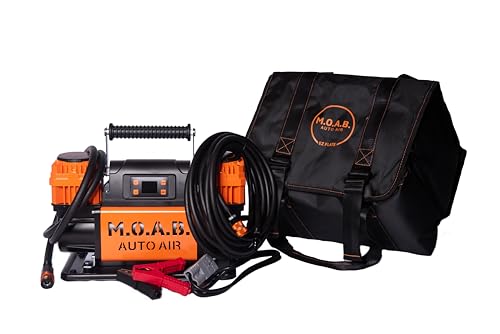
Looking for fast, set-and-forget tire inflation on big rigs and trail setups? We like the EZ FLATE M.O.A.B. Auto Air Compressor for its AUTO AIR mode and LCD that lets us set target PSI and walk away. The dual-cylinder design pushes 10.6 CFM (300 LPM) up to 150 PSI, ideal for Overlanders, crawlers, trailers, and beach deflation re-fills.
It’s a 12V, battery-powered unit (0.17 HP max) best clipped to the vehicle battery. You get a 26 ft hose, 5 ft lead hose, pressure gauge, air chuck, and three nozzle adapters in a heavy-duty bag. Users praise speed and accuracy; verify PSI if readings seem off. Warranty: 3 years.
Best For: Overlanders, off-roaders, and trailer owners who want fast, set-and-forget inflation for large tires via a 12V battery-powered compressor with auto shutoff.
Pros:
- Fast inflation with 10.6 CFM dual-cylinder output up to 150 PSI, great for big tires and multi-tire setups
- AUTO AIR mode with LCD lets you set target PSI and auto shut off for hands-off convenience
- Includes 26 ft hose, lead hose, gauge, air chuck, and adapters in a heavy-duty storage bag; 3-year warranty
Cons:
- Draws significant power; best when clipped directly to vehicle battery and may strain weak batteries
- Can generate heat during extended use; requires cool-down awareness
- Some reports of gauge/reading variances—advised to verify PSI with an external gauge if precision is critical
DEWALT 25 Gallon Vertical Air Compressor, Portable, 200 PSI

July 11, 2026 8:25 am
Need a portable workhorse that still hits 200 PSI? We like DEWALT’s DXCM251.COM for job sites and garages needing steady air without a giant footprint. Its 25-gallon vertical tank, belt drive, and 2 HP motor deliver 7.7 CFM at 40 PSI and 6.2 CFM at 90 PSI—enough for most pneumatic tools. The high-flow regulator and coupler maximize delivery, while the oil-lubed pump, aluminum head, and valve plate boost durability and cooling. At 79 dB, it’s reasonably quiet. Weighing 179.6 lb, it still rolls well on 10-inch pneumatic wheels. Ideal for inflating, wrenching, and nailing; warranty available upon request.
Best For: Pros who need a portable, high-pressure (200 PSI) compressor with solid CFM for common pneumatic tools in garages or job sites without the footprint of a larger stationary unit.
Pros:
- 200 PSI max with 6.2 CFM @ 90 PSI and 7.7 CFM @ 40 PSI supports most impact wrenches, nailers, and general shop tasks
- Quieter belt-drive, oil-lubed pump with aluminum components for durability, cooling, and efficiency (79 dB)
- Portable vertical design with 10-inch pneumatic wheels and high-flow regulator/coupler for strong air delivery
Cons:
- Heavy at 179.6 lb; still cumbersome to load into vehicles despite wheels
- 120V, 2 HP setup may have longer recovery for air-hungry continuous-use tools
- Oil-lubed pump requires periodic maintenance compared to oil-free units
6.3 Gallon Ultra Quiet Oil-Free Air Compressor (2.5HP, 115 PSI)

July 8, 2026 8:45 am
Quiet power in a portable package makes this 6.3-gallon, 2.5HP oil-free unit a smart pick for DIYers and pros who value low noise and reliable output. We get 3.2 SCFM at 90 PSI and a max of 115 PSI from its 1100W, 3450 RPM motor, with a reasonable 75 dBA noise rating. The 3-layer Q235B steel tank, anti-rust coating, and seamless welds boost longevity. Dual cooling fans, thermal protection, and automatic shut-off elevate safety.
With the wheel kit and handle, moving it’s easy. It powers nailers, spray guns, and tire inflation well. Expect slower recovery on continuous, high-demand tools. Warranty info via product page.
Best For: DIYers and professionals who need a portable, ultra-quiet, oil-free compressor for nailers, tire inflation, light spray work, and general shop tasks without excessive noise.
Pros:
- Ultra-quiet operation at 75 dBA with oil-free, low-maintenance design
- Solid 3-layer Q235B steel tank with anti-rust coating and seamless welds for durability
- 3.2 SCFM @ 90 PSI and 115 PSI max with dual cooling fans and thermal protection for safety
Cons:
- Slower recovery for continuous, high-demand air tools (e.g., nibblers, heavy spraying)
- 6.3-gallon capacity limits sustained runtime compared to larger shop compressors
- Warranty specifics not fully detailed upfront; must check product page for terms
40 Gallon 2-Stage Industrial Air Compressor (15HP, 175 PSI, 24 CFM)
July 10, 2026 7:32 am
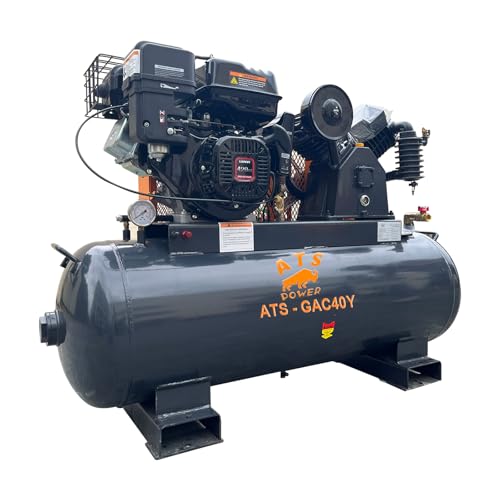
Serious shops that demand high pressure more than sheer volume will appreciate this 40-gallon, 2-stage unit delivering 24 CFM at up to 175 PSI from a stout 15HP RATO OHV engine. We get recoil or electric start, a regulated charging system, and low‑oil shutdown for protection. The ASME-certified steel tank and cold‑rolled, powder-coated construction handle harsh environments.
A 3-cylinder, oil-free pump cuts maintenance while vibration-dampening components reduce noise. The 1-1/2 inch output and ball valve support high-volume airflow to multiple tools. At 43×17×38 inches and 360 lbs, it’s compact yet industrial. Backed by a satisfaction guarantee, 24/7 support, and a 7-day return/exchange policy.
Best For: Industrial workshops, fabrication shops, and heavy-duty job sites that need reliable high pressure (up to 175 PSI) and steady 24 CFM output from a compact, low-maintenance unit.
Pros:
- 15HP RATO OHV engine with electric/recoil start and low-oil shutdown for reliable, protected operation
- Two-stage, 175 PSI performance with 24 CFM and 1-1/2 inch output/ball valve for feeding multiple tools
- ASME-certified 40-gallon, powder-coated steel tank with vibration-dampening and oil-free 3-cylinder pump for low maintenance and durability
Cons:
- 360 lbs weight and industrial size can be challenging to move without equipment
- Oil-free pump design may be louder under heavy load compared to some oil-lubricated units
- 7-day return/exchange window is relatively short for commercial buyers
Factors to Consider When Choosing 40 Cfm Air Compressors
As we compare 40 CFM units, we’ll focus on true CFM at the working PSI, duty cycle ratings, and the power source each model requires. We’ll also weigh tank size and type for airflow stability and portability. Finally, we’ll factor in noise levels and cooling design to ensure reliable, comfortable operation.
True CFM at PSI
Why does “true CFM at PSI” matter so much? Because it’s the real airflow your tools see at the pressure they require. True CFM at a given PSI usually falls as PSI rises, thanks to compressor characteristics and tank design. That’s why many units tout big numbers at 40 PSI but deliver less at 90–150 PSI. We should verify CFM across the pressure range we’ll actually use.
To compare models fairly, match ratings at the same test pressure—typically 90 or 100 PSI. Two-stage compressors generally hold higher CFM at elevated PSI than single-stage designs by compressing in two steps, cutting heat and pressure drop. Plan capacity for how you work: peak CFM for short bursts and sustained CFM at the required PSI for steady tool operation.
Duty Cycle Rating
How long can a compressor actually run before it needs a breather? That’s the duty cycle, the percentage of time the unit can operate in a set period—think 80% as 45 minutes on, 10 minutes off in a 55-minute cycle. For 40 CFM machines, a higher duty cycle means longer continuous operation without overheating, which matters when our tasks push runtime limits.
We should verify the rating’s test point. Some brands state duty cycle at a specific CFM and PSI; stray from those conditions and performance can drop. Cooling is the driver here: better fans, intercoolers, and thermal management support higher duty cycles and prevent thermal shutoff.
If we expect intermittent heavy use, a higher duty cycle reduces forced rest periods and keeps productivity steady.
Power Source Needs
Where will we pull enough power to feed a true 40 CFM compressor? Most units at this output need 240V single-phase or, better yet, three-phase power to hold pressure without sag. We should confirm service availability before buying.
For portability, figure on 1- or 2-stage, 20–25 HP packages to reliably hit 40 CFM with a workable duty cycle. Electric models list full-load amps; we must size breakers, wire gauge, and receptacles for both continuous draw and startup surge, or we’ll trip protection.
Off-grid? Diesel or gasoline compressors solve the location problem but add weight, fuel logistics, and noise. Whichever route we choose, look for automatic unload or shutoff controls to reduce idle draw, protect the motor, and keep power demand predictable under changing loads.
Tank Size & Type
A right-sized tank keeps a 40 CFM compressor from chasing pressure and overheating. Tank volume dictates how long we can deliver high airflow before the pump must reload. Larger tanks—think 40 gallons versus 6.3—support longer continuous runs and fewer cycles, which steadies pressure and lessens wear.
We also weigh tank type. Steel construction and ASME certification add durability and safety for high-pressure storage, improving reliability and consistent recovery. Pairing a two-stage pump with a larger tank helps sustain rated CFM at working pressure, trimming duty cycles during heavy use.
Noise and Cooling
Why does noise and cooling matter so much at 40 CFM? Because sustained airflow means long duty cycles, higher heat, and more time listening to the machine. Most large-CFM units land between 70–85 dB, while ultra-quiet options hover near 75 dB. If we’re working in shared spaces or indoors, those few decibels can make a real difference in comfort and communication.
Cooling is just as critical. Oil-free pumps cut maintenance and heat transfer pathways, but they can run hotter under continuous loads, so they need robust airflow management. Two-stage compressors tend to move air more efficiently, which can reduce heat generated per CFM. We look for thermal protection, relief valves, and strong cooling airflow—whether via built-in fans or clear external airflow paths—to safeguard performance.
Portability & Weight
With heat and noise under control, we also have to think about how we’ll move a 40 CFM compressor from job to job. Portability starts with weight and footprint: lighter, compact frames travel easier, while big tanks and two-stage pumps add serious bulk. Most “portable” 40 CFM systems still weigh hundreds of pounds, so plan for two-person lifts, dollies, or a pallet jack.
We look for wheel kits, sturdy handles, and smart orientation. Vertical units park tightly in vans; horizontal layouts roll better across job sites. Integrated wheels, low‑vibration mounts, and ergonomic access points reduce strain and jostling during transit. Power matters, too—models set up for horizontal mobility typically run on standard electrical hookups or generator support, avoiding permanent wiring and keeping deployment fast and flexible.
Conclusion
We’ve covered a spectrum of compressors to match real shop demands, from portable quick-fills to heavy-duty, high-capacity workhorses. For true 40 CFM performance, we’d prioritize two-stage, oil-lubed units with 40+ gallon tanks, robust cooling, and reliable safety features for long duty cycles. Balance pressure needs, duty cycle, noise, and portability with your workflow. When in doubt, size up—steady airflow beats peak specs every time. Choose wisely, and your compressor will power productivity for years.


