Power on tap is the lifeblood of a job site, and small gas air compressors are the portable veins that feed it. We’re zeroing in on 2025’s top compact gas units that balance CFM, PSI, weight, and runtime without wasting space or fuel. We’ll compare engines, tank sizes, noise, and duty cycles, and flag who each pick suits best. If you move between tasks or tools often, the next choice could save you hours—and headaches.
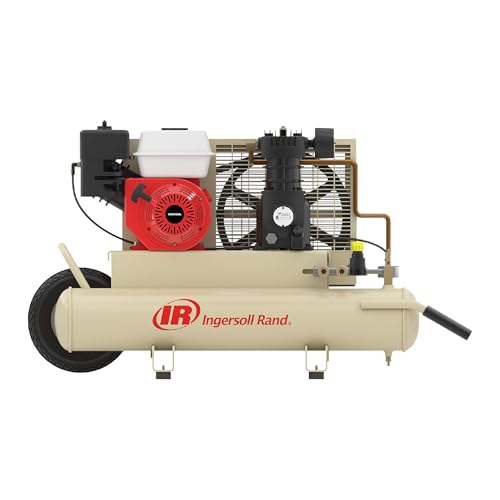
Ingersoll-Rand 5.5 HP 8-Gallon Gas Twin Pontoon Air Compressor

July 10, 2026 12:35 am
If you need a portable, job-site workhorse that runs where outlets don’t, the Ingersoll-Rand SS3J5.5GH-WB stands out with its Honda 5.5 HP engine, 8-gallon twin-pontoon tanks, and true 100% continuous-duty rating. We like its wheelbarrow layout, cast-iron durability, and 135 psi max for nailers, impact tools, and inflating. Two quick disconnects let us run multiple tools, and the pressure switch, regulator, and gauges keep control simple. It’s gas-powered, oil-lubricated, single-stage, and rated 89 dB. At 226 pounds, it’s hefty yet manageable. Reviews praise easy starts; some note leaks, vapor lock, or warranty hassles. Warranty: one year with proof of purchase.
Best For: Contractors and serious DIYers who need a durable, gas-powered, portable compressor for job sites without electrical power, running nailers, impact tools, and other air tools continuously.
Pros:
- Honda 5.5 HP engine with reliable starts and true 100% continuous-duty rating
- Twin 8-gallon pontoon tanks and two quick disconnects for running multiple tools
- Cast-iron, wheelbarrow-style design with 135 psi max for rugged job-site use
Cons:
- Heavy at 226 lb, making transport and loading more challenging
- Reported issues: occasional leaks, vapor lock after shutdown, and warranty/service hassles
- Loud at 89 dB and requires oil-lubricated maintenance and fuel management
DEWALT 30 Gallon Gas Air Compressor (175 PSI, Truck Mounted)

July 7, 2026 8:28 pm
Built for crews who live out of their service trucks, DEWALT’s 30 Gallon Gas Air Compressor (DXCMH5593011) pairs a HONDA GX160 engine with a 175 PSI, 30-gallon tank to deliver reliable, high-pressure air on remote sites. We like its low oil shutdown and automatic idle control, which cut risk and fuel use. The oil-lubricated, twin-cylinder pump and poly-v belt drive run smoothly, while the aluminum flywheel maximizes airflow.
An isolated platform, cast iron crankcase, and metal belt guard boost durability and safety. Vibration-absorbing design reduces noise. At 276 pounds, it’s for truck mounting, not hauling. Ideal for long shifts and demanding pneumatic tools.
Best For: Service-truck crews and mobile technicians who need reliable, high-pressure air (up to 175 PSI) on remote job sites for long shifts and demanding pneumatic tools.
Pros:
- HONDA GX160 engine with low oil shutdown and automatic idle control improves safety and fuel efficiency
- Oil-lubricated twin-cylinder pump with poly-v belt and aluminum flywheel delivers smooth operation and strong airflow
- Rugged, truck-mounted design with isolated platform, cast iron crankcase, and metal belt guard for durability and reduced vibration/noise
Cons:
- Heavy at 276 lb, intended for permanent truck mounting rather than portability
- Gas engine requires regular maintenance and fuel, adding operating costs and emissions
- 30-gallon tank size and dimensions may demand significant truck bed space and careful mounting considerations
DeWalt 4 Gallon Gas-Powered Air Compressor (DXCMTA5590412)

July 11, 2026 12:27 am
Looking for a compact gas unit that still drives framing guns and roofing tools? We like DeWalt’s 4 Gallon Gas-Powered Air Compressor (DXCMTA5590412) for punchy output in a portable frame. The Honda GX160 OHV 163cc engine and oil-free, direct-drive pump deliver 5.0 SCFM at 90 psi (6.9 at 40) up to 155 psi. Twin 2-gallon pontoon tanks improve stability; the 93-pound package stays manageable on rooftops. A patented 2-piece cooling system with multi-chamber exhaust cuts noise and improves cooling. You get a 1/4 in regulator, gauges, and a push-to-connect coupler. It’s low-maintenance, jobsite-tough, and ready for framing, roofing, and trim tools.
Best For: Contractors or serious DIYers who need a compact, portable gas compressor with enough output to run framing, roofing, and trim tools on jobsites or rooftops.
Pros:
- Strong performance for size: 5.0 SCFM at 90 psi (6.9 at 40) with 155 psi max handles nailers and many pneumatic tools
- Reliable Honda GX160 engine with oil-free, direct-drive pump for reduced maintenance and easy starts
- Twin 2-gallon pontoon tanks and multi-chamber exhaust for better stability, cooling, and lower noise
Cons:
- At 93 lb, it’s portable but still heavy to lift frequently or solo up ladders
- Gas-powered engine adds fuel, exhaust, and noise considerations vs. electric units
- Single 1/4 in regulator and one quick coupler may limit multi-tool use without additional manifolding
2840-20 2 Gallon Compact Quiet Compressor

July 10, 2026 4:34 am
Quiet power stands out here: the 2840-20 2 Gallon Compact Quiet Compressor runs at just 68 dB(A), making it a smart pick for finish carpenters and DIYers working in occupied spaces. We like its portable, low-profile, stackable design and 35.3-pound weight. With a 2-gallon tank and 1.2 CFM output, it’s tuned for trim and brad nailing, delivering up to 1,600 brads per charge on M18 REDLITHIUM packs (sold separately). The cordless 120V, 2 HP unit measures 20 x 12 x 21 inches and fits easily in a truck. User reviews cite fast pressure build and reliability, though one board failure was reported. Warranty and returns are straightforward.
Best For: Finish carpenters, trim installers, and DIYers needing a quiet, portable, cordless compressor for indoor or noise-sensitive job sites.
Pros:
- Very quiet at 68 dB(A), ideal for occupied spaces and indoor work
- Portable, low-profile, stackable design at 35.3 lb; fits easily in a truck
- Up to 1,600 brad nails per charge with M18 REDLITHIUM battery compatibility
Cons:
- 1.2 CFM and 2-gallon tank limit it to light/finish tasks vs. high-demand air tools
- Batteries sold separately; adds to total cost
- Some reports of cosmetic damage on arrival and an isolated board failure in reviews
30 Gal Gas-Powered Air Compressor, 13HP, 35 CFM, Electric Start, ASME Tank

July 11, 2026 11:43 am
Need serious air volume on a service truck without jumping to a tow-behind? We like HPDAVV’s 30 Gal Gas-Powered Air Compressor: 13 HP, 35 CFM at 105–125 PSI, and an electric start. The 30-gallon ASME tank, 3-cylinder cast-iron pump (880 rpm), and 1/2-inch NPT outlet make it a strong fit for mobile service, construction, and light industrial work.
At 429 pounds and 46.8 x 20.4 x 44.4 inches, it’s built for mounting, not lifting. One-stage compression handles nailing, drilling, and spraying without constant run. EPA certified (RCGPS.4202GR-019). Note the carbon monoxide hazard, review warranty details, and expect mixed user feedback around shipping and support.
Best For: Mobile technicians and contractors who need high CFM air on a service truck without moving to a tow-behind compressor.
Pros:
- 35 CFM at 105–125 PSI with 13 HP engine and electric start for reliable on-site power
- Durable ASME 30-gallon tank and cast-iron 3-cylinder pump (880 rpm) for long service life
- 1/2-inch NPT outlet and truck-mount design ideal for mobile service and light industrial tasks
Cons:
- Heavy (429 lb) and bulky; designed to be mounted, not easily portable
- One-stage design limits max pressure to 125 PSI; not for high-pressure applications
- Mixed user feedback on shipping and warranty support; carbon monoxide hazard requires outdoor use
Gas Driven 6.5HP Wheelbarrow Portable Air Compressor, 9 Gal, 12 CFM @ 125 PSI
--
Built for crews who bounce between sites, this 6.5 HP wheelbarrow compressor pairs a durable single-stage cast-iron pump with twin 9-gallon tanks to deliver about 11–12 CFM at 125 PSI—enough for framing guns, roofing nailers, and light sanders without dragging cords. We like its iron construction, cast cylinder sleeves, and serviceable pump head for longevity. At roughly 132 lb with handles and wheels, it’s easy to load, and it mounts cleanly in a truck bed for service work. Expect gas convenience but outdoor-only use—engine exhaust contains carbon monoxide. Verify CFM listings (11 vs 12). Warranty: one year product, two years air end, lifetime maintenance.
Best For: Contractors and service crews who need a portable, gas-powered compressor for jobsite mobility and consistent 11–12 CFM at 125 PSI for framing, roofing, and light pneumatic tools.
Pros:
- Durable single-stage cast-iron pump with serviceable head and cast cylinder sleeves for long life
- Twin 9-gallon tanks and 11–12 CFM at 125 PSI handle most nailers and light sanders without power cords
- Wheelbarrow design with handles and wheels; mounts cleanly in a truck bed for service work
Cons:
- Gas engine requires outdoor-only operation due to carbon monoxide exhaust
- Spec variance (11 vs 12 CFM) requires verification for accurate tool matching
- Approximately 132 lb; portable but still heavy and may require two-person loading on some vehicles
VEVOR 13.2 Gallon Gas Powered Air Compressor (7HP, 9 CFM @ 115 PSI)

July 11, 2026 12:27 am
Looking for dual-outlet versatility without a trailer-size tank? VEVOR’s 13.2-gallon gas compressor gives us 7HP and 9 CFM at 115 PSI, enough for nailers, spray guns, an impact wrench, and sanding. It inflates tires fast (about two minutes) and the dual outlets let us run two tools at once. Cast iron cylinders boost durability, and the automatic low-oil shutoff protects the pump. At 131.8 pounds with wheels and a push handle, it’s jobsite portable for outdoor, long-distance tasks. Expect high noise and mixed reliability reviews. Includes a 25-foot, 1/2-inch hose. EPA COC listed. Warranty available plus Amazon’s 30-day return.
Best For: Contractors or DIYers who need a portable, gas-powered compressor with dual outlets to run two pneumatic tools on outdoor jobsites without hauling a trailer-size tank.
Pros:
- 7HP engine with 9 CFM at 115 PSI supports nailers, spray guns, impact wrenches, and sanding; fast tire inflation (~2 minutes)
- Dual outlets for running two tools simultaneously; stable air delivery reduces frequent cycling
- Durable cast iron components and automatic low-oil shutoff; wheeled, push-handle design for jobsite mobility
Cons:
- High noise levels noted by users
- Mixed reliability reviews and some shipping/delivery issues
- Heavier at 131.8 lb; still portable but not ideal for frequent lifting without ramps or help
NorthStar Portable Gas Powered Air Compressor, 30-Gallon, 24.4 CFM at 90 PSI

July 7, 2026 8:28 pm
Serious air demand on remote sites calls for the NorthStar Portable Gas Powered Air Compressor, driven by a Honda GX390 OHV engine and delivering 24.4 CFM at 90 PSI. We like its 30-gallon horizontal tank and full cast iron pump with an FC35-grade head and V-style cylinders to keep temps in check. The GX390 includes electric start with recoil backup, low-oil shutdown, and a 3-amp charging circuit.
At 13 HP and 0.5-inch hose compatibility, it feeds spraying, nailing, drilling, and even light sanders. It’s heavy at 490 lb, but portable enough for trailers. Owners report strong reliability and value, backed by solid ratings and return support.
Best For: Contractors and serious DIYers who need high CFM, jobsite-ready compressed air in remote locations without electrical power.
Pros:
- Powerful Honda GX390 OHV engine with electric start, low-oil shutdown, and 3A charging for reliable, easy starts
- High output: 24.4 CFM at 90 PSI and 30-gallon tank supports spraying, nailing, drilling, and light sanding
- Durable full cast iron pump with FC35-grade head and V-style cylinders for cooler operation and long service life
Cons:
- Very heavy at 490 lb; practical for trailers but cumbersome to move around frequently
- Requires gasoline and periodic engine maintenance; louder than electric compressors
- Battery for electric start not included; 0.5-inch hose compatibility may require new fittings for some setups
Metabo HPT 8-Gallon Gas Wheeled Air Compressor (EC2510E)

July 8, 2026 4:44 am
Need a compact gas unit that still drives framing, roofing, and siding nailers all day? We like Metabo HPT’s EC2510E. Its professional-grade Honda GX engine and cast iron cylinder deliver reliable power in a durable 8-gallon package. The 116–145 PSI range and low oil carryover help tools last, while the integrated control panel protects gauges and plumbing. It’s 144 pounds with a handle and wheels for jobsite mobility, and noise is a reasonable 70 dB.
We appreciate the full-size 3/8-inch locking regulator, though some users report 1/4-inch outlets—double-check fittings. Included: synthetic oil, filter, belt, gauge, and hardware. Backed by a 1-year warranty.
Best For: Contractors and serious DIYers who need a compact, gas-powered compressor to reliably run framing, roofing, siding, and finish nailers on the jobsite.
Pros:
- Honda GX engine and cast iron cylinder deliver reliable, professional-grade performance
- Integrated control panel and 3/8-inch locking regulator for protected, centralized control
- Portable 8-gallon, wheeled design with 70 dB noise level and included setup accessories
Cons:
- Heavy at 144 lb, which can be cumbersome to load and unload
- Mixed reports on outlet size (3/8 vs 1/4 NPT) may require adapter or fittings
- Only a 1-year warranty compared to longer coverage offered by some competitors
Metabo HPT THE TANK 8-Gallon Trolley Air Compressor (EC1315S)

July 14, 2026 4:48 am
For crews who juggle multiple nailers without a trailer-sized rig, Metabo HPT’s THE TANK EC1315S stands out with 225 PSI and 5.0 CFM at 90 PSI, delivering more pressure and airflow than typical small compressors. We like that it’s rated to run three framing nailers or up to five finish nailers and keep nails driving flush. The 8-gallon trolley design, rubber tires, and ergonomic handle help us move its 93 pounds across rough sites. It’s corded (120V), relatively quiet at 76 dB, and compact. Expect mixed real-world feedback: strong on portability and output, but some users question usable PSI. Backed by a 1-year warranty.
Best For: Crews needing a compact, jobsite-tough compressor that can reliably power multiple nailers without stepping up to a gas or trailer unit.
Pros:
- High output for size: 225 PSI and 5.0 CFM at 90 PSI supports 3 framing or up to 5 finish nailers
- Mobile 8-gallon trolley design with rubber tires and ergonomic handle; relatively quiet at 76 dB
- Durable, compact build with 120V convenience; backed by 1-year Metabo HPT warranty
Cons:
- Heavy at 93 lbs; still bulky for frequent lifting without ramps
- Mixed user feedback on real-world usable PSI versus gauge rating
- 1.5 HP motor and 8-gallon capacity may limit continuous duty on air-hungry tools beyond nailers
Factors to Consider When Choosing Small Gas Air Compressors
As we pick the right small gas air compressor, we’ll match power and CFM to our tools, confirm the max PSI rating, and size the tank for the duty cycle we expect. We’ll also weigh portability features—frame style, handles, wheels, and weight—to fit how we move around jobsites. Finally, we’ll choose an engine type that balances reliability, maintenance, fuel efficiency, and noise.
Power and CFM
Two numbers drive a small gas compressor’s real-world usefulness: horsepower and CFM at a given PSI. Horsepower tells us how much work the engine can sustain; CFM tells us how much air the pump actually delivers to our tools. Small gas units usually pair 6.5–13 HP engines with twin-pontoon or compact tanks to keep usable CFM while staying mobile.
We should match CFM at our target operating pressure to the tools we’ll run. Ratings vary by pressure—one model might deliver 6–9 CFM across 40–115 psi—so we check the CFM where we’ll operate. Intermittent, light-duty tasks can live with lower CFM at moderate pressure. Continuous, heavy-duty work needs higher CFM and enough tank volume to reduce cycling and maintain steady airflow.
Max PSI Rating
How high should our max PSI really be? The max PSI rating tells us the highest pressure a compressor can deliver, typically 90–225 PSI on small gas models. But higher max PSI doesn’t guarantee more usable air. What matters at the tool is CFM at the operating pressure.
For most framing and nailer work, a 125–135 PSI max covers us, since many tools run best within a 105–125 PSI working range that balances performance and engine efficiency. If we’re driving specialized fasteners or running tools that specify higher intake pressure, stepping up to 175–225 PSI makes sense.
Let’s match max PSI to our tools’ requirements. We should confirm the tool’s pressure spec, ensure the compressor delivers adequate CFM at that pressure, and avoid oversizing that adds cost without benefit.
Tank Capacity
We matched max PSI to our tools; now let’s talk about the air reserve that keeps them running—tank capacity. Small gas units typically span 2 to 9 gallons. Capacity dictates how long we can run a tool at a given CFM/PSI before refilling, which directly affects job pacing. Twin-tank designs store more air than single-tank models of the same size, smoothing pressure dips between cycles.
For most job-site tasks, 4 to 9 gallons supports intermittent use of nailers, staplers, and short bursts with impact tools, though continuous heavy demand still forces frequent recharges. An 8-gallon twin-tank often hits the sweet spot—extended runtime with manageable overall weight around 200-plus pounds on some models. Larger tanks (13.2 to 30 gallons) reduce cycling and boost lower-pressure CFM, but they add handling challenges on tight sites.
Portability Design
When portability makes or breaks a day’s workflow, design details matter. We look for frames that move as well as they perform. Wheelbarrow-style and trolley layouts put integrated handles and stout wheels to work, so we can cross gravel, ramps, and door thresholds without wrestling the unit. Compact tanks—around 8 gallons—shrink footprint and weight, trading some continuous air for easier lifting and loading.
We also value lightweight builds with quick pull-start or electric-start convenience, which speeds setup when we’re hopping between tasks. Integrated gauges and regulators by the control panel help us check pressure on the fly, instead of stopping to reorient. Finally, overall weight and dimensions—say, 48L x 27W x 33H—dictate whether the compressor fits storage bays and rolls neatly into a truck bed.
Engine Type
Curious which engine will keep air flowing without drama? We look for proven gasoline powerplants in the 5.5–13 HP range because they deliver portable output when there’s no outlet nearby. Honda GX-series and comparable OHV engines top our list; they start easily, run smoothly, and have reputations for long service life.
Oil lubrication is a must, so we confirm easy access to the fill and drain points and verify a low-oil shutoff to protect the engine if levels drop. Starting options matter in the field: electric start saves time in cold mornings, while recoil with a battery backup adds a safety net.
Most small gas compressors pair these engines with one-stage, direct- or belt-drive pumps sized for smaller tanks and steady site use.
Duty Cycle
Though specs like horsepower grab attention, duty cycle tells us how long a small gas compressor can actually work before it needs a breather. It’s the percentage of time the pump can run in a given period without overheating—commonly 50%, 60%, or 100%. A 100% duty cycle means true continuous operation, great for long inflating sessions or steady tool use. A 50% rating means equal run and rest time—think 5 minutes on, 5 minutes off.
Let’s match duty cycle to the workload. If we run nailers intermittently, a midrange rating may suffice. For grinders, sanders, or paint sprayers that demand steady airflow, we should prioritize 100%. Check ratings tied to CFM at a specific PSI; they indicate how long airflow can be sustained, reducing overheating, pressure drops, and premature wear.
Noise Levels
Duty cycle tells us how long a compressor can run; noise determines how tolerable that runtime feels on a job site. Small gas units span roughly 68–89 dB. Quieter models sit near 68–70 dB, while high-output, industrial-leaning machines push close to 89 dB.
We should match noise expectations to the work. Higher CFM often means more sound, so if we’re framing or running multiple nailers, we’ll likely accept extra dB. For punch-list tasks near occupied spaces, target the low-70s with noise-reduction features like multi-chamber exhausts and vibration-absorbing frames.
Engine type and mounting matter. Wheelbarrow and trolley designs can isolate vibration better than rigid truck mounts. Oil-free pumps tend to be quieter than oil-lubricated single-stage units, though cast-iron cylinders and well-designed intakes can reduce harshness.
Maintenance Needs
How much upkeep will a small gas compressor demand week to week? We should match maintenance to the pump type and workload. Oil-lubricated units need regular oil checks and changes; a sight glass makes this quick. Oil-free pumps skip lubrication, but we still inspect seals, couplings, and overall condition.
Usage dictates service intervals. Even 100% continuous duty models need periodic belt tension checks, valve inspections, and fitting reviews to catch leaks early. Every few uses, we tighten tank drains, confirm regulator gauges read true, and test quick-connect fittings to maintain consistent output.
Fuel care matters, too. To prevent vapor lock and fuel drainage issues after shutdown, we stabilize fuel, follow proper ignition procedures, and store the unit correctly. Clear maintenance access and parts availability simplify all of this.
Conclusion
So, does the “small gas compressor equals compromise” theory hold? We don’t think so. When we match PSI/CFM to our tools, choose the right tank size, and value reliable engines like Honda GX, these compact units deliver serious job-site power. Sure, we trade a bit on weight and maintenance, but portability, runtime, and versatility win. Let’s pick the model that fits our duty cycle and mobility needs—and prove small, gas-powered compressors can punch well above their size.