Have we ever wrestled with a job site that’s just out of reach of power, yet still needs serious compressed air, all day long?


What Makes This Compressor Stand Out?
When we look at a portable gas-powered compressor, we want to know why we should drag it onto our truck instead of another model. With the Ingersoll-Rand SS3J5.5GH-WB 5.5 Horsepower 8 Gallon Oiled Gas Twin Pontoon Compressor, the appeal comes from a mix of power, reliability, and portability that suits demanding, real-world work.
This machine is purpose-built for crews who need continuous air away from electrical outlets. Instead of being a compromise between power and mobility, it tries to give us both in one rugged wheelbarrow-style package.
Key Features at a Glance
We often like to see the essentials laid out clearly before committing to a big purchase. The core specifications and design elements give us a snapshot of whether this compressor fits our kind of work.
Here is a simple breakdown of the main details:
| Feature | Specification / Description |
|---|---|
| Product Name | Ingersoll-Rand SS3J5.5GH-WB 5.5 Horsepower 8 Gallon Oiled Gas Twin Pontoon Compressor |
| Power Source | Gas-powered |
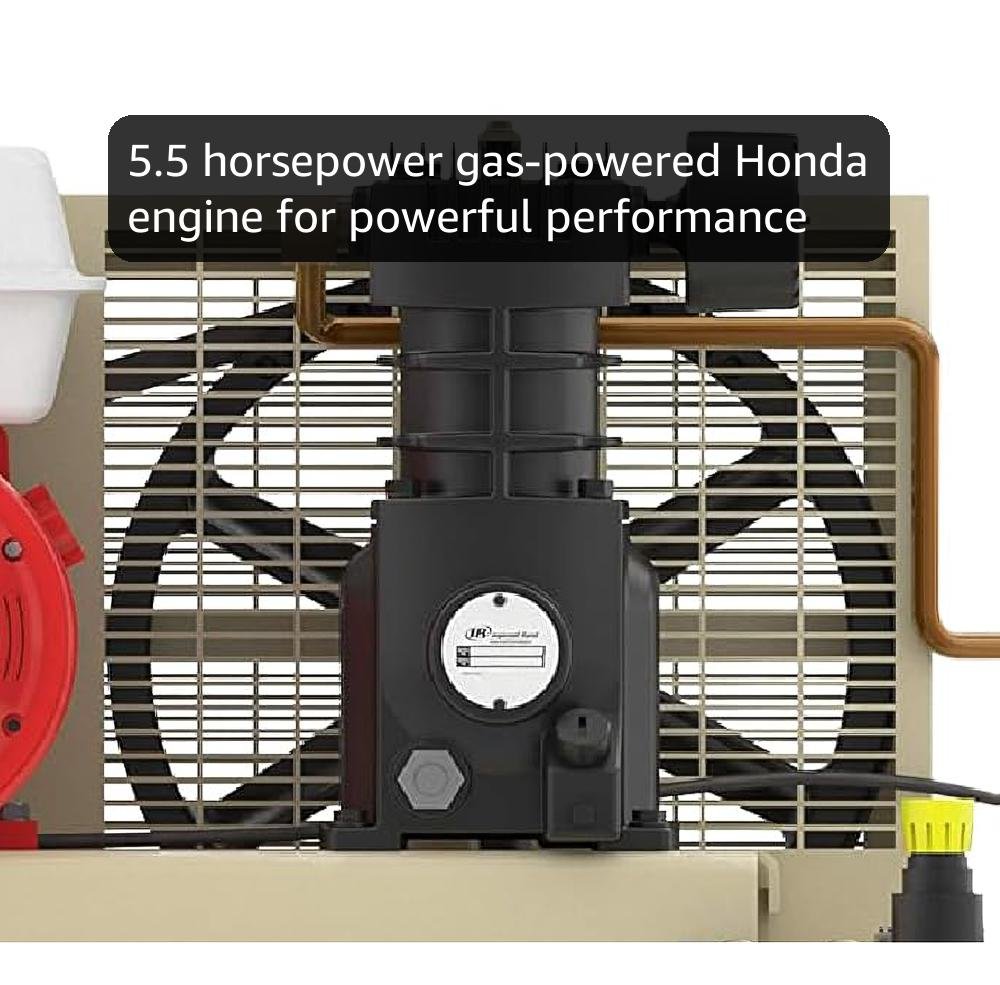
| Engine | 5.5 horsepower Honda engine |
| Fuel Tank Capacity | 0.825 gallons |
| Maximum Operating Pressure | 135 psi |
| Duty Cycle | 100% continuous duty operation |
| Tank Style | Twin pontoon / twin tank |
| Tank Capacity | 8 gallons total (combined) |
| Design | Wheelbarrow design with handles and wheels for portability |
| Construction | Durable cast iron components |
| Air Outlets | 2 quick disconnects for multiple tools |
| Typical Use Cases | Construction, framing, roofing, finishing, light automotive, remote job sites |
This quick look shows us that we are dealing with a serious, job-ready compressor, not a light DIY unit. Now we can walk through what all of this means in daily use.
Portability and Wheelbarrow Design
Portability isn’t just about having wheels; it’s about how easily we can maneuver the compressor through the real obstacles we see on job sites. Mud, gravel, cords, scrap lumber, and tight corners all test a compressor’s design.
The wheelbarrow frame on this Ingersoll-Rand model places the twin tanks in a pontoon arrangement, balanced with the engine and pump. This setup lets us tilt the unit back and move it using the handles, much like a contractor’s wheelbarrow.
Maneuvering Around the Job Site
We know how frustrating it is to drag a heavy, awkward compressor over rough ground. The twin pontoon design spreads the weight low to the ground, so the unit feels stable when we lift it by the handles. It is meant to be rolled, not carried, which saves our backs and keeps the compressor from tipping.
The wheelbarrow form also helps us navigate places where a stationary compressor would be stuck. Doorways, ramps, and uneven terrain are easier to manage when we can steer the weight instead of pushing it blindly or carrying it in pairs.
Footprint and Storage
Another aspect of portability is how the unit fits into our truck or van. The narrow, elongated body of this wheelbarrow-style compressor helps squeeze it alongside other tools, nailers, and materials. The twin tanks sit horizontally, and the engine and pump are arranged compactly.
In storage, we can tuck it against a wall in a shop or garage without it swallowing an entire bay. That makes it practical for crews who share space or move equipment between multiple locations.
Gas-Powered Honda Engine: Power and Independence
For us, the heart of this compressor is the Honda 5.5 horsepower gas engine. It is the core reason we consider a gas unit in the first place: independence from the grid and from long extension cords that waste power and trip breakers.
With 5.5 HP on tap, this compressor is built to feed air-hungry tools in conditions where an electric motor simply isn’t an option.
Why 5.5 Horsepower Matters
Horsepower isn’t just a number to brag about; it affects how quickly we can recharge the tanks and maintain pressure while using demanding tools. With 5.5 HP, we have enough force to keep 135 psi on tap in a relatively compact 8-gallon system.
This output helps when we’re running multiple finish guns or a framing nailer and a small air tool at the same time. The compressor doesn’t bog down as easily or spend as much time recovering between bursts of use.
Honda Engine Reputation
We tend to trust Honda engines because they’ve earned a strong reputation for reliability across a wide range of power equipment. On job sites, a Honda-powered machine usually means easy starts, low vibration, and fewer engine-related headaches.
This matters for two reasons:
- Fewer interruptions – We don’t want to fight with a pull cord when we’re racing a deadline.
- Long-term investment – When the engine holds up, we’re not replacing equipment every couple of seasons.
Knowing we have a Honda engine under the shroud usually gives us more confidence that this compressor will stay in service for years with basic care.

Fuel Capacity and Runtime
Fuel capacity might sound modest at 0.825 gallons, but gas-powered compressors are often tuned for efficiency relative to their workload. The smaller tank also keeps weight down, which is important when we’ve got a portable unit that we’re rolling and loading regularly.
We typically plan our day around how often we have to shut down to refuel. With just under a gallon of gas, we can generally expect several hours of intermittent, real-world use, depending on how hard we push the compressor.
Working Through a Typical Day
On a framing or roofing job, the compressor doesn’t run constantly at full output. Instead, it cycles: building tank pressure, idling, and restarting as we use air. That cycling lets a smaller fuel tank stretch longer than we might expect.
With a 0.825-gallon tank, we should expect to refuel occasionally during all-day work, but we don’t need to haul a massive amount of gas just for the compressor. We also keep in mind that a modest fuel tank reduces the risk of old, stale fuel sitting in the machine for long periods.
Balancing Runtime and Portability
There’s always a tradeoff between runtime and weight. A larger tank adds bulk and makes the compressor heavier and harder to wheel around. Ingersoll-Rand seems to have chosen a middle ground here, giving us practical runtime without turning the unit into a beast to move.
For crews who like to keep fuel cans on hand, topping off the tank during a break becomes just another quick habit, not a major interruption.
135 PSI Maximum Operating Pressure
Operating pressure is one of the first specs we scan, because it tells us whether the compressor can support the tools we use without constant frustration. With a maximum operating pressure of 135 psi, this unit fits nicely into the typical range for many job-site tasks.
We can generally run most framing nailers, roofing nailers, finish nailers, staplers, and some lightweight pneumatic tools comfortably at this level.
Tool Compatibility
Most common air tools have recommended operating ranges somewhere between 70 and 120 psi. Having 135 psi available gives us a cushion, so the compressor can cycle without dropping below the minimum pressure our tools need to function properly.
We don’t want a nailer misfiring or failing to sink nails flush because the system can’t keep up during peak use. This compressor’s 135 psi ceiling aims to keep us steady, especially when running more than one tool.
Pressure for Continuous Work
On tasks like framing, we can be firing nailers continuously as we stand up walls or set trusses. On roofing, we might be running a nailer almost non-stop as we move across a deck. In both situations, the combination of 135 psi and a 100% duty cycle (which we’ll cover next) is crucial.
Instead of waiting for tanks to catch up, we get a more predictable workflow. That steadiness adds up to better productivity and fewer bottlenecks.
100% Continuous Duty Operation
The phrase “100% continuous duty” is one of the most meaningful claims in the product description. It means this compressor is built to run without mandatory cool-down periods, assuming we follow proper guidelines for maintenance and environment.
We’re not just talking about occasional short bursts; we’re talking about long stretches of work at or near full load.
What Continuous Duty Means for Us
Some compressors are rated for partial duty, which means the pump and motor shouldn’t run constantly at full power, or we’ll overheat the system and shorten its lifespan. A 100% continuous duty rating tells us the pump and engine are intended to withstand demanding conditions.
For us, that translates into real confidence when:
- Running air tools throughout the day on a busy site
- Feeding two tools from the dual quick disconnects
- Operating in hot weather with extended use
We still need to be smart about ventilation and routine checks, but we’re not forced to babysit the compressor just to prevent thermal overload.
Productivity on Demanding Jobs
Continuous duty aligns well with jobs that require sustained air output: sandblasting small areas, running impact wrenches off and on in an auto setting, or driving thousands of nails in a single shift.
Instead of mentally tracking how long the compressor has been under load, we can focus on the work, trusting that the Ingersoll-Rand system is designed with that level of usage in mind.
Durable Cast Iron Construction
Durability isn’t glamorous until something breaks. Then we wish we had paid closer attention to materials and build quality. With this compressor, the cast iron construction stands out as a sign that Ingersoll-Rand expects it to face tough treatment in the field.
Cast iron typically points to a compressor that can handle heat cycles, vibration, and wear better than lighter, cheaper materials.
Why Cast Iron Matters
Cast iron components, especially in the pump, resist scoring and distortion when exposed to heat and pressure over long periods. That helps maintain tight tolerances inside the compressor, which is critical for efficient air compression.
We also appreciate that cast iron tends to:
- Reduce flexing in key parts
- Absorb some vibration
- Extend the service life of the pump
In daily use, this means fewer unexpected breakdowns and a longer interval before major overhauls become necessary.
Suitable for Harsh Environments
On many job sites, equipment gets banged around, coated in dust, and exposed to temperature changes. Cast iron construction can stand up better to those conditions than lighter-duty consumer-grade units.
While we still need to protect the compressor from extreme abuse, having a rugged build gives us more confidence tossing it in a truck bed or pushing it in and out of work areas day after day.
Twin Pontoon Tank Design and 8-Gallon Capacity
The twin pontoon tanks provide a combined capacity of 8 gallons. Instead of a single upright or horizontal tank, we get two parallel tanks that form a stable base and contribute to the wheelbarrow layout.
We want tanks that hold enough air to buffer our tools’ demand without becoming too heavy or awkward.
Balance Between Capacity and Mobility
With 8 gallons, this compressor lands in a sweet spot between ultra-portable small units and large, stationary shop tanks. The twin pontoon layout spreads the air storage along the base, keeping the center of gravity low.
This design:
- Helps prevent tipping during movement
- Makes the compressor feel more stable when parked on uneven ground
- Provides enough capacity to handle bursts of high demand
We might not get the same volume as a 20–30 gallon stationary compressor, but we are trading tank size for portability and mobility, which is exactly the point of a wheelbarrow model.
Performance With Common Tools
In real terms, an 8-gallon setup at 135 psi with a 5.5 HP engine means we can comfortably run:
- Framing nailers
- Roofing nailers
- Finish and brad nailers
- Staplers
- Blow guns
- Light impact tools
This capacity supports both single-tool use and moderate multi-tool use, especially in tasks that involve intermittent firing rather than continuous air bleed.
Dual Quick Disconnects for Multiple Tools
Two quick disconnects can be a big productivity boost. Instead of swapping hoses every time someone else needs air, we can plug in two tools and keep everyone working.
We like this feature in particular when we’re operating in a small crew that shares a single compressor.
Working as a Team
With dual outlets, one person can be framing while another handles finishing touches or runs a second nailer. Or on a roofing job, we can have two roofers working from the same air source without interrupting each other.
This reduces wasted time and minimizes frustration. There’s less arguing over whose turn it is to use the compressor and fewer delays switching lines around.
Managing Air Demand
We do need to keep in mind that two tools at once also double the air demand. Fortunately, the 5.5 HP engine and 100% duty cycle help the compressor keep up with this increased load.
If we are running two heavy-demand tools constantly, there will still be limits, but for many construction and finishing tasks that are more start-and-stop, the system remains very practical.
Oiled Pump: Maintenance and Longevity
The SS3J5.5GH-WB features an oiled pump design, which is typical for higher-end compressors built for durability. This means there is a crankcase and oil that needs to be checked and changed periodically.
We trade the convenience of oil-free operation for better wear resistance and longer overall life.
Benefits of an Oiled Pump
Compared to oil-free designs, an oiled pump generally:
- Runs cooler
- Lasts longer under heavy-duty use
- Operates more quietly (within reason for a gas compressor)
- Handles continuous duty better
For us, that makes sense on a gas-powered, job-site compressor intended to work hard and often. The pump benefits from lubrication over thousands of hours.
Maintenance Responsibilities
The tradeoff is that we must commit to basic maintenance routines, such as:
- Checking oil levels regularly
- Changing oil at recommended intervals
- Watching for leaks and contamination
- Keeping the unit reasonably clean
If we’re already maintaining other gas tools, adding oil checks for the compressor is not a major burden. It’s a small price to pay for extended durability and more reliable performance.
Real-World Use Cases
To decide whether this compressor belongs in our fleet, it helps to imagine where it fits into specific types of work. The specs tell part of the story, but the real value appears when we picture the unit on our jobs.
We can think of the Ingersoll-Rand SS3J5.5GH-WB as a strong fit for construction, remodeling, small to medium roofing jobs, and mobile operations where we don’t have guaranteed power.
Construction and Framing
For framing crews, this compressor offers a solid combination of mobility, power, and reliability. We can roll it inside a partially built structure, up ramps, or across rough ground. Once in place, it provides enough capacity to keep framing nailers running smoothly.
We can also operate two nailers at once via the dual quick disconnects, which suits small teams trying to maximize productivity. The continuous duty design helps handle long runs of heavy firing without forcing us into cooling breaks.
Roofing and Siding
Roofing and siding often put us in locations where power isn’t easily accessible. Having a gas-powered compressor means we can position it on the ground or a stable area and run hoses up to the roof or along a wall.
The wheelbarrow design helps us reach the best position without too much physical strain. We get the air pressure we need for shingle, metal, or siding nailers while benefiting from the ability to run two tools at once.
Remodeling and Finish Work
For remodelers, the portability and gas engine mean we are more independent from the client’s power situation. If the main panel is off or circuits are overloaded with other trades’ tools, we can still keep moving with our own compressor.
Finish nailers and brad nailers don’t draw air as heavily as framing guns, so the 8-gallon tank and 135 psi output feel more than sufficient. The twin pontoon design also helps us tuck the compressor in a corner or outside, keeping noise and exhaust away from the main work area.
Light Automotive and Mobile Services
For mobile mechanics or service trucks, this compressor can serve as a compact, portable air source for:
- Light impact work
- Inflating tires
- Running small air tools
- Occasional cleaning and blowing
While it may not replace a large shop compressor for high-volume air tools, it gives us a strong, field-capable option for off-site repairs and service calls.
Noise Levels and Work Environment
Gas-powered compressors are loud; there’s no way around that. Between the engine and the pump, we’re dealing with significant sound output. This is the nature of having that level of power in a portable format.
Instead of pretending it’s quiet, we should plan for hearing protection and thoughtful placement on the job.
Practical Noise Management
We usually place the compressor a short distance away from where most of the crew is concentrated. With long hoses, we can keep the noise and exhaust out of confined spaces or away from interior rooms.
Hearing protection is essential for regular use, especially for anyone who has to stand near the unit when it’s cycling frequently. It’s wise to factor the sound level into our workflow, particularly in residential neighborhoods or noise-sensitive environments.
Working Indoors vs. Outdoors
Because this compressor is gas-powered, we need to use it in well-ventilated or outdoor spaces. Running it in closed environments is not safe due to exhaust fumes. For indoor-only work in finished spaces, an electric compressor is usually the better choice.
That said, for shell construction, open framing, or external work, this Ingersoll-Rand model shines by giving us solid power independent of the building’s electrical system.
Pros and Cons Overview
It’s often helpful to summarize the main strengths and potential drawbacks so we can quickly compare this compressor to other options we’re considering.
Advantages
- True portability thanks to the wheelbarrow design and twin pontoon layout
- Strong power with a 5.5 HP Honda gas engine
- Independence from electricity, ideal for remote or early-stage job sites
- 135 psi maximum operating pressure for a wide range of tools
- 100% continuous duty rating for demanding, all-day work
- Durable cast iron construction designed for long-term reliability
- Two quick disconnects to support multiple tools at the same time
- Oiled pump for better wear resistance and longer life
These strengths combine to give us a compressor that feels purpose-built for serious contractors, remodelers, and mobile professionals.
Potential Drawbacks
- Gas engine noise and exhaust, limiting use in enclosed spaces
- Regular maintenance needs, such as oil changes and engine care
- Fuel management, requiring us to carry and store gasoline
- Weight, which, while manageable with the wheelbarrow design, can still be substantial
- Not ideal for very high CFM industrial tools, where larger, stationary compressors excel
These considerations don’t disqualify the unit, but they remind us to match the compressor to the right kind of work.
Maintenance and Care Tips
To get the most out of this compressor, we need to treat it as a serious piece of equipment, not a disposable tool. A few simple routines can extend its life substantially and keep it performing at its best.
We can view maintenance as a regular investment in productivity rather than a chore.
Basic Maintenance Practices
Some simple habits that help:
- Check oil levels in the pump before heavy use days
- Change pump oil at the intervals recommended by Ingersoll-Rand
- Maintain the Honda engine with proper oil, air filter cleaning, and spark plug checks
- Inspect hoses and quick disconnects for leaks or wear
- Drain moisture from the tanks periodically to prevent rust and internal corrosion
By making these steps part of our weekly or monthly workflow, we reduce the chance of surprise failures on busy days.
Storage and Transport
When we’re not using the compressor:
- Store it in a dry area, away from heavy dust and direct moisture
- Avoid stacking items on top of the unit
- Secure it during transport to prevent severe shocks or tipping
If we treat it like any other major piece of power equipment, it will reward us with a longer service life and fewer headaches.
Who This Compressor Is Best For
Not every crew or user needs this level of gas-powered capability. Understanding who benefits most helps us decide whether it belongs in our arsenal.
In our view, the Ingersoll-Rand SS3J5.5GH-WB is tailor-made for professionals and serious users who have consistent, heavy-duty needs away from dependable power.
Ideal Users
We’d especially recommend this model for:
- Framing and construction crews who frequently work on new builds or additions
- Roofing and siding contractors needing mobile, gas-powered air on developing sites
- Remodelers working in varied conditions, sometimes without reliable electrical service
- Mobile mechanics and service techs who need compact, portable air for field work
- Tradespeople who value continuous duty and multiple-tool use in a portable package
If we fit these profiles, the compressor’s strengths line up well with our typical day-to-day demands.
Less Ideal Situations
This compressor might be more than we need if:
- We mostly work indoors on finished spaces with easy access to power
- Our tool use is very light and occasional
- We prefer ultra-quiet operation, such as in occupied residential interiors
- We have no interest in maintaining a gas engine or oiled pump
In those cases, a smaller electric, oil-free unit would probably make more sense.
Long-Term Value and Investment
When we consider the price tag of a professional-grade compressor, we are really asking ourselves whether it will earn its keep. Long-term value comes from reliability, uptime, and the ability to handle the workloads we throw at it.
The Ingersoll-Rand SS3J5.5GH-WB positions itself as an investment piece of equipment that can form a backbone of portable air for our operation.
Cost vs. Reliability
We might pay more upfront for this model than for a budget compressor, but the cast iron construction, Honda engine, and continuous duty rating point toward a lower cost over time. Breakdowns, replacements, and lost workdays are where cheaper units often cost us more in the long run.
If we plan to use a compressor heavily, day after day, spending more on a durable, well-engineered unit usually pays off.
Resale and Reputation
Equipment from brands like Ingersoll-Rand and engines from Honda tend to hold their reputation over time. If we ever upgrade to a different setup or move into a larger stationary system, a well-maintained unit like this can retain decent resale value in the used market.
That doesn’t guarantee a specific return, but it adds another dimension to the idea of long-term value.
Final Thoughts: Is It the Right Fit for Us?
When we put all the pieces together—wheelbarrow portability, 5.5 HP Honda power, 135 psi output, 100% continuous duty, cast iron durability, and dual quick disconnects—we are clearly looking at a compressor built for real work, not casual weekend projects.
If our work regularly takes us to sites without convenient power, if we run air tools heavily throughout the day, and if we care about reliable performance over many seasons, the Ingersoll-Rand SS3J5.5GH-WB 5.5 Horsepower 8 Gallon Oiled Gas Twin Pontoon Compressor is a strong contender.
It is not the quietest, lightest, or simplest machine out there, but it is purpose-built for serious users who need a portable, gas-powered compressor that won’t quit when the work gets demanding. For crews and professionals who fit that description, this unit can be a dependable partner on countless jobs.

Disclosure: As an Amazon Associate, I earn from qualifying purchases.