Are we looking for a single air compressor that can handle serious home projects, support a busy workshop, and still be convenient enough for occasional DIY jobs?
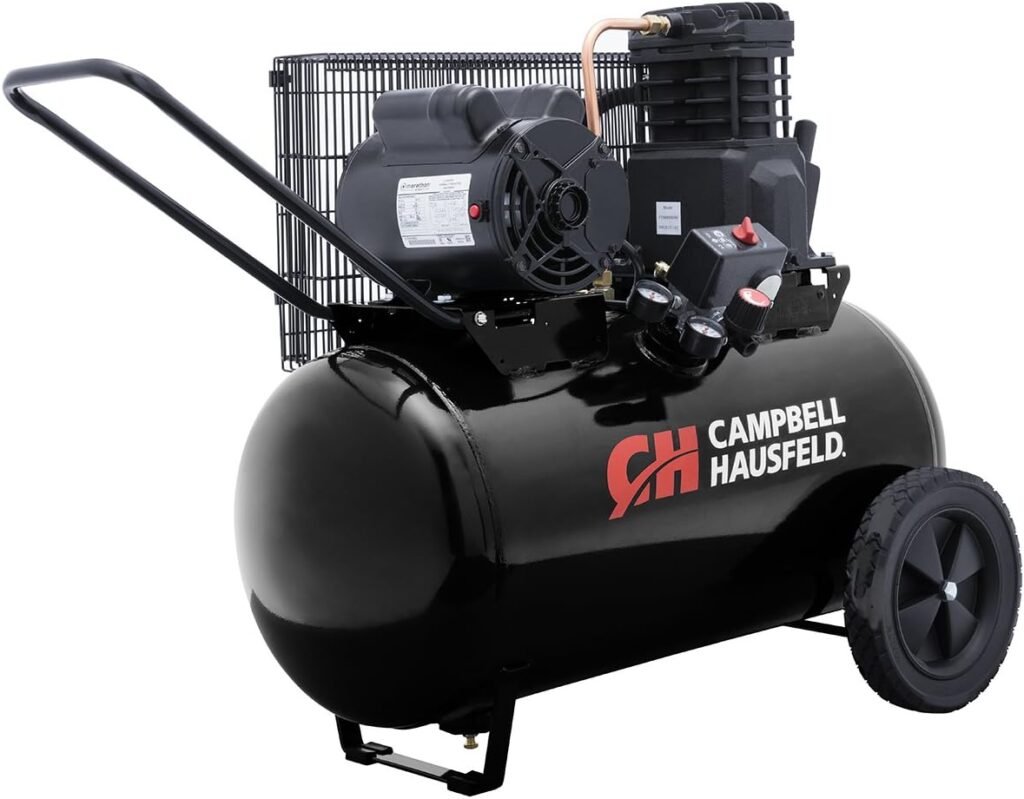

Why We Chose the CAMPBELL HAUSFELD 20 Gallon Horizontal Air Compressor
We were searching for a compressor that could keep up with real-world tasks, not just occasional tire fills. The CAMPBELL HAUSFELD 20 Gallon Horizontal Air Compressor, Dual Voltage 120V/240V, 135 Max PSI, 5.5 CFM at 90 PSI, Oil Lubricated Pump, Portable Air Compressor for Versatile Home and Workshop Use stood out as a practical middle ground between small portable units and massive shop systems.
We appreciate that it’s built for both home users who want room to grow and workshop owners who need a reliable, steady performer. It’s not just about peak numbers; it’s about consistent output, durability, and ease of use.
Key Specs at a Glance
We find it helpful to look at the core specifications in a simple format before we think about real-life use. These numbers tell us what kind of tools and tasks we can realistically handle.
Here’s a quick breakdown of the essentials:
| Feature | Specification |
|---|---|
| Tank Capacity | 20 gallon horizontal tank |
| Maximum Pressure | 135 PSI |
| Air Delivery | 5.5 CFM at 90 PSI |
| Pump Type | Oil-lubricated, belt-driven (with metal belt guard) |
| Power Options | Dual voltage: 120V or 240V |
| Portability | Semi-pneumatic wheels for easier movement |
| Intended Use | Versatile home and workshop use |
| Construction Focus | Heavy-duty performance and durable components |
We see these specs as a solid baseline for medium-duty applications. It’s clearly built for more than just light hobby use, but it doesn’t require industrial power service or a huge footprint.
Performance: Power, PSI, and Real-World Use
When we talk about air compressors, performance isn’t just about maximum PSI. We care more about how consistently a compressor can supply air for the tools we actually use.
With 135 max PSI and 5.5 CFM at 90 PSI, this compressor is designed to run many common air tools comfortably. We notice a particular strength in tasks that benefit from steady airflow rather than short bursts.
We find that for home garages and small to medium workshops, these performance levels strike a good balance. It’s not a monster shop compressor, but it’s far beyond the “tiny, takes forever to refill” type of unit.
What 5.5 CFM at 90 PSI Really Means for Us
The CFM rating at 90 PSI tells us how well the compressor can keep up with airflow-hungry tools. At 5.5 CFM, we’re in a range that supports a surprisingly wide variety of pneumatic tools.
We can think of it this way: the compressor is strong enough for extended use of smaller to mid-size tools, but we still need to be mindful of the heaviest continuous-duty tools.
Here’s a rough idea of tool compatibility in simple terms:
| Tool Type | Typical Requirement | How This Compressor Handles It |
|---|---|---|
| Tire inflators & blow guns | Low CFM, moderate PSI | Easily handled; quick and consistent |
| Finish / brad nailers | Low CFM, low duty cycle | Excellent; near constant readiness |
| Framing nailers | Moderate CFM, intermittent | Very good; keeps up well for typical framing work |
| Impact wrenches (3/8″ or 1/2″) | 4–5+ CFM, intermittent | Well matched; strong performance for garage work |
| Ratchets & small grinders | Around 4–6 CFM, intermittent | Good; fine for typical short-to-medium bursts |
| HVLP spray guns (smaller setups) | ~4–7 CFM, mostly continuous | Usable; best for smaller jobs with mindful pacing |
| Die grinders / sanders (continuous) | 6–10+ CFM, continuous | Light to moderate use; may cycle more often |
We wouldn’t consider this a continuous-use solution for the most air-hungry tools, but for typical home and workshop projects, the 5.5 CFM rating is comfortably practical.
135 Max PSI: Why It Matters
The 135 PSI max pressure gives us a decent margin above the typical 90 PSI many tools specify. That extra pressure means the tank stores more usable compressed air, helping reduce cycling during use.
We notice this especially when we’re running tools that operate at or near 90 PSI. The compressor doesn’t instantly kick back on after just a few moments of use, and we get longer working windows between refill cycles.
Tank Size and Horizontal Design
The 20 gallon tank puts this compressor squarely into the mid-size category. For us, this feels like a “just right” size when we want more than a small portable unit but don’t want the space demands of a huge stationary tank.
The horizontal layout makes it easier to tuck alongside a wall or under some shelving in a garage or workshop. We appreciate that we can have substantial air capacity without a tall vertical footprint that might interfere with storage or overhead space.
We see this tank size as particularly helpful for tasks that use a moderate amount of air over time, such as:
- Running a framing nailer for a home project
- Swapping tires and using an impact wrench for a full vehicle
- Using a blow gun for extended cleaning
- Light to medium painting tasks with smaller guns or parts
Oil-Lubricated Pump: Durability and Maintenance
The heart of this compressor is its oil-lubricated pump, and we view that as a strong feature for longevity and smooth operation. Oil lubrication generally means reduced wear on internal components, quieter performance compared to many oil-free units, and a longer service life when we maintain it properly.
We understand that this comes with a trade-off: we need to check and change the oil at appropriate intervals. For us, that’s a fair exchange for better durability and reliability over time.
Pros and Cons of an Oil-Lubricated Design
We like to be honest with ourselves about what any design choice means day-to-day. Here’s how we see the oil-lubricated system:
What we like:
- Smoother, often quieter operation than many oil-free compressors
- Longer potential life span with proper maintenance
- Better suited for heavier, repeated use in workshop environments
What we need to accept:
- Periodic oil checks and oil changes are required
- Possibility of oil carry-over, which means we may want filters for ultra-clean air (for sensitive paint or finish work)
- Slightly more involved initial setup and maintenance versus a “plug and forget” oil-free unit
For us, if we’re serious about using air tools regularly, the oil-lubricated pump feels like the right direction. We see it as investing some small maintenance effort in exchange for long-term reliability.
Safety Features: Fully Enclosed Metal Belt Guard
The compressor includes a fully enclosed metal belt guard, which is one of those things we don’t appreciate until we imagine the alternative. Open or partially protected belts can be risky, especially in a busy workshop or a home garage where kids or pets might occasionally pass through.
We see the metal guard as a key safety and durability component. It helps prevent accidental contact with moving parts and shields the belt and pulleys from damage and debris.
We like knowing that the moving components are secured, not only for safety but also for protecting the belt from tools, cords, or materials that might accidentally fall into the mechanism.
Dual Voltage Flexibility: 120V and 240V
One of the standout features for us is the dual voltage motor. This compressor can run on 120V or 240V, making it adaptable to different electrical setups.
We appreciate this flexibility because it gives us options as our workspace evolves. Maybe we start in a standard residential garage with a 120V outlet and later add a 240V line when we upgrade our workshop.
When We’d Use 120V vs 240V
The option to switch between voltages allows us to tailor the setup to our space:
-
120V mode:
- Best when we’re plugging into standard household outlets.
- Ideal for home garages or temporary setups where we don’t want to run new wiring.
-
240V mode:
- Typically offers more efficient operation and can reduce amp draw.
- Great for dedicated workshops or garages with upgraded electrical service.
We like that we’re not locked into one electrical scenario. That means the compressor can move with us from a basic garage to a more serious workshop without becoming obsolete.
Mobility and Portability: Semi-Pneumatic Wheels
Even though this is not a tiny compressor, it’s designed with semi-pneumatic wheels to help us move it around. We see this as a valuable feature for those of us who work in more than one area or need to reposition the compressor occasionally.
We don’t necessarily want to lift and carry something of this size, and we don’t have to. The wheels and stable design help us roll it across typical garage floors or shop spaces without a struggle.
Everyday Movement and Storage
We find that being able to move the compressor makes a difference in how often we use it. If equipment is difficult to reposition, we tend to avoid setting it up for quick jobs.
With the semi-pneumatic wheels:
- We can roll it closer to a project area to avoid long hose runs.
- We can reposition it for better sound control or ventilation.
- We can store it more neatly when not in use by sliding it against a wall or into a corner.
In our experience, this level of portability makes the unit feel more “usable” day to day, not just for big, planned projects.

Build Quality and Durability
We see multiple signs that this compressor was designed with durability in mind: the oil-lubricated pump, the metal belt guard, the sturdy tank, and the heavy-duty overall design.
We interpret “heavy duty” here as the ability to handle frequent use without quickly wearing down. It’s not designed as a disposable, short-lifespan machine; it feels more like a long-term piece of shop equipment.
We also notice that the general construction approach favors protection of critical components. The belt and pump are guarded, the tank feels robust, and the basic layout seems focused on both performance and safety.
Use Cases: Where This Compressor Fits Best
To decide whether this unit is right for us, we like to match its capabilities to specific scenarios. That helps clarify if it’s overkill, underpowered, or just right for our situation.
For Home Garages and DIY Users
For the typical home user who wants more than a tiny inflator, this compressor offers a lot of value. We see it as a strong choice if we’re planning:
- Vehicle maintenance (tire changes, impact wrench work, topping off tires)
- Light carpentry or renovation (framing nailers, finish nailers)
- Occasional painting of small parts, cabinets, or furniture
- Cleaning tasks (blowing dust off workbenches, equipment, and filters)
We like that it gives us room to grow our tool collection. If we start with nailers and tire inflators, we can later add impact wrenches and some spray equipment without needing an entirely new compressor.
For Small Workshops and Hobby Shops
In a dedicated workshop or hobby space, we often need something more robust. We see this compressor fitting well into:
- Woodworking shops that use nailers, brad guns, and blow-off tools
- Automotive hobby garages that use impacts, ratchets, and air chisels intermittently
- Metalworking or fabrication spaces that occasionally run grinders or rivet guns
We probably wouldn’t base a full-time professional auto shop around this single unit, but for a serious hobbyist or small workshop, it strikes a nice balance between capacity and footprint.
For Light Professional and Contractor Use
For tradespeople, we recognize that air demand can quickly escalate with multiple tools and workers. Still, for certain professional scenarios, this compressor can make sense:
- Small contractors using one or two pneumatic nailers on job sites
- Remodelers who need a reliable, mid-size unit for varied tasks
- Service professionals who want a flexible compressor for both shop and mobile work
We see it as a solid “one or two-person” compressor in a professional setting. If we expect heavy, constant multi-tool use all day, every day, we might want to supplement it or step up to a larger industrial unit.
Noise and Everyday Comfort
While exact noise figures aren’t specified in the details we have, we can infer some things based on the oil-lubricated pump and belt-driven design. These designs tend to be quieter and smoother than many small, direct-drive oil-free compressors.
We still expect it to make a noticeable amount of noise—after all, it’s a mechanical pump compressing air—but compared to some shrill, lightweight units, this should feel more manageable.
We can further control how intrusive it feels by:
- Positioning it in a corner or against a wall
- Using longer air hoses to keep the compressor farther from where we’re working
- Placing it on a solid, level surface to reduce vibration
From our perspective, the noise level falls into a “reasonable for a serious compressor” category, especially for garage and workshop environments.
Setup, Use, and Maintenance
We always like to consider the practical side: how easy is it to get started and keep things running smoothly?
Getting Started
With any compressor, including this one, we’d plan to:
- Confirm whether we’re using 120V or 240V and wire/outlet accordingly.
- Check oil level in the pump and top off if necessary.
- Attach any quick-connect couplers we plan to use on the outlet.
- Run an initial break-in period if recommended by the manufacturer.
We find that a little attention upfront can significantly extend the life of our equipment, and this unit is no exception.
Regular Maintenance
Because of the oil-lubricated pump, we’ll need to stay on top of routine maintenance. Typical tasks include:
- Checking oil level regularly and topping off as needed.
- Changing oil at recommended intervals.
- Draining the tank frequently to remove moisture and reduce rust risk.
- Periodically checking hoses, couplers, and safety valves.
We see this as standard practice for any serious compressor. A few minutes of maintenance now and then pays dividends in reliability and safety.
Advantages of the CAMPBELL HAUSFELD 20 Gallon Horizontal Air Compressor
We like to lay out the strengths clearly so we can see where this compressor really shines. Based on the product details and the design, here’s what stands out for us:
- Heavy-duty performance up to 135 PSI for demanding tasks
- 5.5 CFM at 90 PSI for solid support of common shop and garage tools
- 20 gallon tank providing a good reserve for medium-duty work
- Oil-lubricated pump for durability and smoother operation
- Fully enclosed metal belt guard for added safety and component protection
- Dual voltage (120V/240V) flexibility for different power setups
- Semi-pneumatic wheels to help us move the unit where we need it
- Versatile use cases, from home DIY to workshop and light professional tasks
We feel these advantages make it a smart middle-ground investment—more capable than small, portable “starter” units but not as demanding as large industrial systems.
Limitations and Things to Consider
No compressor is perfect for every situation, and we like to be realistic about trade-offs. We’d consider the following before deciding it’s the right fit for us:
- It’s larger and heavier than small portable units, so not ideal for frequent loading into vehicles by hand.
- The oil-lubricated pump means we need to commit to regular maintenance.
- It may not fully satisfy continuous, all-day use of extremely high CFM tools such as large sanders or continuous spray operations.
- Running at 240V may require additional electrical work if our space currently has only standard 120V outlets.
We don’t see these as dealbreakers for typical users, but we do want to be clear about where its sweet spot lies.
How It Compares to Smaller Portable Units
Many of us start with small, very portable compressors and then hit their limits. Compared to those compact units, this CAMPBELL HAUSFELD model brings several upgrades:
- Much higher air capacity with a 20 gallon tank versus 1–6 gallon tanks
- Better CFM at 90 PSI, meaning it can run more demanding tools more effectively
- Dual voltage instead of being limited to 120V
- Heavier-duty construction, more like proper shop equipment
We give up some ultra-portability and “grab-and-go” convenience, but we gain the ability to actually run a broader range of tools properly.
How It Compares to Large Stationary Compressors
On the other hand, compared to big stationary shop compressors, this unit is more compact and flexible:
- It occupies less space and can be moved thanks to its wheels.
- It requires less complex installation since it isn’t permanently mounted.
- It offers enough performance for many tasks without the cost and power requirements of large industrial systems.
We see it as a strong choice when we want serious capability but aren’t ready—or don’t have the room—for a large, fixed compressor.
Who We Think This Compressor Is Ideal For
After reviewing the features and imagining daily use, we can picture several types of users who would benefit most from this model:
- Committed DIYers and home mechanics who want reliable air power for vehicles, repairs, and projects.
- Hobby woodworkers and metalworkers who use nailers, blow guns, and intermittent higher-demand tools.
- Small workshop owners who need a reliable mid-range compressor for one or two users.
- Contractors and remodelers who want a robust unit that can live in a workshop but also be transported between job locations when necessary.
We don’t see it as overkill for serious enthusiasts, nor as underpowered for most home tasks. Instead, it fills a very practical “workhorse” role.
Practical Scenarios Where It Shines
To really picture value, we like to think about everyday scenarios:
- We’re rotating tires and using an impact wrench on each lug—this compressor keeps up, rather than running dry after a few bolts.
- We’re using a framing nailer for a deck or wall project—the tank size and CFM rating handle intermittent bursts just fine.
- We’re cleaning sawdust from a table saw and other tools—a good blast of air with a blow gun is no problem.
- We’re painting a set of cabinet doors with a compatible spray gun—this compressor can manage smaller painting tasks if we pace ourselves and use the right setup.
These kinds of use cases show us where the blend of pressure, CFM, and tank capacity really adds up.
Value for Money and Long-Term Ownership
When we look at value, we don’t just consider the initial price. We think about:
- How long the compressor is likely to last
- How well it supports our current and future tool needs
- How manageable the maintenance is over time
The oil-lubricated pump and heavy-duty construction suggest that, with reasonable care, this unit can serve us for years. That longevity helps spread out the cost and reduce the chance we’ll need to upgrade quickly.
We see it as a smarter long-term investment than a cheap, underpowered compressor that we’ll outgrow within a few projects.
Final Thoughts: Is the CAMPBELL HAUSFELD 20 Gallon Horizontal Air Compressor Right for Us?
When we bring everything together—the 20 gallon tank, 135 max PSI, 5.5 CFM at 90 PSI, oil-lubricated pump, dual voltage flexibility, and portable horizontal design—we’re looking at a compressor that’s clearly aimed at serious home users and smaller workshops that want reliable, capable equipment.
We like that it balances power, durability, and flexibility without requiring us to dedicate half the shop to a giant stationary system. We also appreciate that it’s built with safety and longevity in mind, from the metal belt guard to the heavy-duty construction.
If we’ve been wanting a compressor that can handle real tools and projects, not just occasional tire inflation, the CAMPBELL HAUSFELD 20 Gallon Horizontal Air Compressor, Dual Voltage 120V/240V, 135 Max PSI, 5.5 CFM at 90 PSI, Oil Lubricated Pump, Portable Air Compressor for Versatile Home and Workshop Use is a strong candidate. It stands out as a dependable workhorse that can serve both our current needs and the more ambitious projects we plan to tackle in the future.

Disclosure: As an Amazon Associate, I earn from qualifying purchases.