Have we ever wished our air compressor setup was powerful enough for serious work, yet quiet enough that we could still hold a normal conversation in the same room?
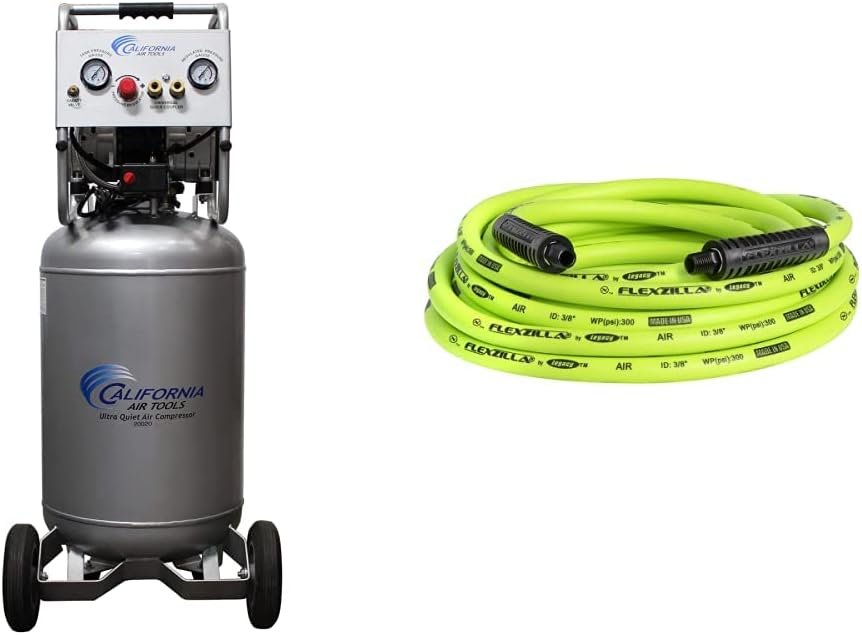

What Is the California Air Tools 20020 Ultra Quiet & Oil-Free Air Compressor?
When we look at the “California Air Tools 20020 Ultra Quiet & Oil-Free Air Compressor 2.0 Hp, 20.0 Gal. Steel Tank Air Compressor & Flexzilla Air Hose, 3/8 in. x 25 ft, 1/4 in. MNPT Fittings,” we are really talking about a complete compressed-air solution rather than a single tool. We get both a large, ultra-quiet compressor and a professional-grade air hose in one bundle.
At its core, this combo is aimed at anyone who wants strong performance without the usual noise and hassle. It is built with the professional in mind but friendly enough for serious DIY users who demand reliability and convenience.
Key Features at a Glance
Before we get into the specifics of how this setup behaves in real use, it helps to see the headline features in one place. These specs tell us a lot about how the compressor and hose will fit into our workshop, garage, or jobsite.
| Feature | Details |
|---|---|
| Brand | California Air Tools + Flexzilla |
| Compressor Type | Ultra Quiet, Oil-Free, 2.0 HP |
| Noise Level | 70 dB (decibels) |
| Tank Capacity | 20.0 gallon steel tank with wheels |
| Pump Type | Oil-free (low maintenance) |
| Motor Power | 2.0 HP (rated/running) |
| Hose Included | Flexzilla Air Hose, 3/8 in. x 25 ft |
| Hose Fittings | 1/4 in. MNPT fittings |
| Target User | Professionals and serious DIY users |
| Notable Hose Traits | Flexible, durable, designed for demanding environments |
With this quick reference in mind, we can walk through how all these pieces translate into real, everyday performance for our projects.
Ultra Quiet Performance: How Quiet Is 70 Decibels?
One of the standout claims is that the compressor runs at only 70 decibels. Numbers on a spec sheet can feel abstract, so we should compare that level to sounds we know from daily life. Many traditional shop compressors are loud enough that we feel the vibration in our chest; this one is very different.
At 70 dB, the sound is closer to a regular conversation or a household vacuum than an industrial machine. We can talk to someone nearby without shouting, and in many shops or garages it becomes background noise rather than a disruptive roar.
Why Low Noise Matters in Daily Use
Noise is not just an annoyance; over time it can affect our focus, comfort, and even our health. If we are using air tools for extended periods, this lower volume becomes a major advantage.
Low noise helps us work longer and more comfortably. It also makes this compressor viable in places where sound is a concern—like home garages in quiet neighborhoods, shared workspaces, or indoors where family or coworkers are close by. We may still prefer hearing protection for long sessions, but we are no longer dealing with a deafening machine.
Oil-Free Pump: Maintenance and Long-Term Costs
The compressor uses an oil-free pump, which is a key design choice with several real-world implications. Unlike oil-lubricated units, we do not need to check, top off, or change oil regularly, which simplifies ownership considerably.
For anyone who has lived with a traditional compressor, eliminating oil maintenance feels like removing a recurring chore. It also reduces the risk of oil contamination in the air line, which can be a big deal for certain tools and finishes.
Benefits of an Oil-Free System
Oil-free pumps have matured a lot over the last several years. With modern designs, we get performance that is good enough for most professional and serious hobby tasks, while skipping the mess and time of oil servicing.
We also save money over the life of the compressor by not buying oil or filters and not scheduling downtime for maintenance. For us, that means more reliable operation and fewer surprises when we need the compressor to just work. We can set it up, use it regularly, and not feel like we need a service logbook to keep up.
20-Gallon Steel Tank with Wheels: Capacity and Mobility
The heart of any compressor setup is the tank. With a 20.0 gallon steel tank, this unit is large enough for sustained use but still portable enough to move around our space. Steel construction provides durability and a sense of stability.
We are not dealing with a tiny pancake compressor that cycles on every few seconds. Instead, the 20-gallon capacity lets us run tools longer between cycles, which feels more professional and less frustrating.
Why Tank Size Matters for Our Tools
Tank size directly affects how long we can run higher-demand tools before the compressor needs to refill. For spray painting, air ratchets, impact wrenches, die grinders, or extended brad/finish nailing, more capacity leads to smoother operation.
A small tank might keep up with a few quick nailer shots, but it can struggle with continuous tasks. This 20-gallon tank hits a sweet spot: big enough for real projects, but not so large that it becomes a permanent fixture we can never roll out of the corner.
Portability with Wheels
The tank is mounted on wheels, which matters more than we might first think. With a steel tank and 2.0 HP motor, this is not a featherweight machine. Wheels turn it from a “static” piece of equipment into something we can reposition as our work area changes.
If we move between rooms, jobsite zones, or just reposition in our garage, we are not fighting with dead weight. We can roll it smoothly to where we need it, connect our hose, and get back to the task more quickly.
The 2.0 HP Motor: Power and Performance
Power ratings can be confusing, but here we have a stated 2.0 HP (rated / running) motor. That means the unit is designed to deliver consistent, real-world power rather than a flashy peak number that only appears on startup.
When we use tools that demand a decent flow of compressed air, we want a motor that does not bog down easily. This 2.0 HP rating places the compressor comfortably in the “serious work” category rather than the “small quick repair” niche.
What This Power Level Means for Our Jobs
A motor at this level can run a broad range of air tools commonly found in a workshop or jobsite. While exact performance also depends on the compressor’s specific CFM ratings and pressure settings (which are not fully detailed in our prompt), 2.0 HP typically supports:
- Framing, finish, and brad nailers
- Staplers and small to medium impact wrenches
- Air ratchets and some grinders (depending on duty cycle)
- Light to medium spray painting and blow guns
- Tire inflation and general shop air tasks
For tasks that require continuous, heavy airflow for long stretches (like industrial sandblasting or running large grinders nonstop), we might still want a larger, stationary compressor. For most professional trades and serious DIY work, this motor size is a strong, versatile choice.
Flexzilla Air Hose: The Second Half of the Package
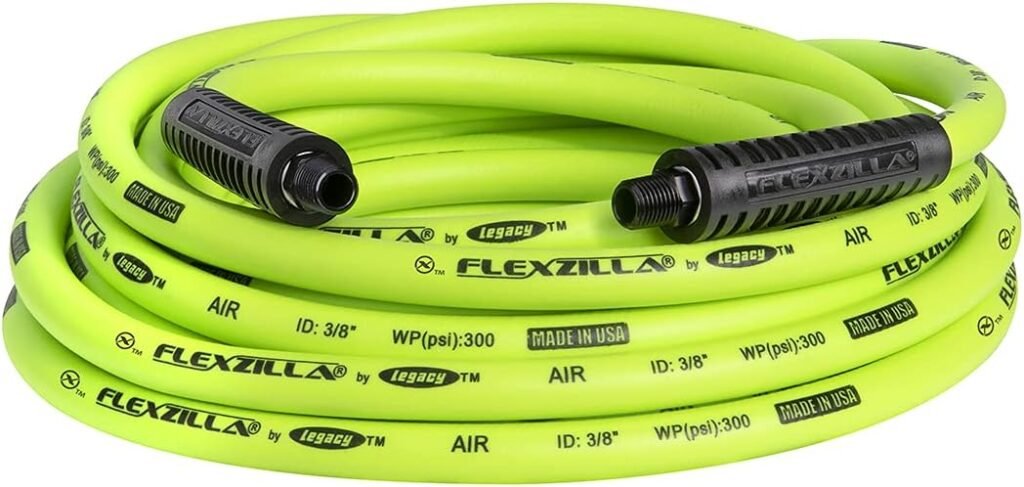
We are not just getting a compressor; this bundle includes a Flexzilla air hose, 3/8 in. x 25 ft, with 1/4 in. MNPT fittings. Flexzilla is known for building durable, flexible hoses that hold up in tough conditions, and this hose complements the compressor nicely.
The hose length and diameter are suited to a range of common tools without feeling bulky, and the fittings are standard enough to integrate with most existing sets of couplers and tools.
What Makes Flexzilla Hoses Stand Out
Flexzilla has built a reputation as a leading manufacturer of high-quality air hoses, often recognized internationally for performance and durability. The brand emphasizes state-of-the-art materials and designs that remain flexible even in challenging temperatures.
That matters because stiff, coiled, or kink-prone hoses are frustrating, slow us down, and can even pose tripping hazards when they do not lay flat. A high-quality hose improves every interaction with our compressor: connecting tools, moving around a vehicle, or working overhead becomes easier and safer.
Hose Specs: 3/8 in. x 25 ft, 1/4 in. MNPT
The hose itself is 3/8 inch in diameter and 25 feet long, with 1/4 inch MNPT (male national pipe thread) fittings on the ends. These details tell us how the hose behaves in use and what we can connect to it.
3/8 inch hoses are common in professional settings because they often offer better airflow than slimmer 1/4 inch hoses, while still being manageable and not overly heavy. A length of 25 feet hits a nice balance between reach and pressure drop.
Why These Dimensions Are Practical
In a typical garage or mid-sized workshop, 25 feet lets us reach across vehicles, workbenches, and machines without dragging the compressor closer every few minutes. If we need more reach, we can add additional hose segments, but for day-to-day work, 25 feet feels manageable and less prone to tangles.
The 1/4 inch MNPT fittings work with a wide range of quick-connect couplers and tools that many of us already own. We are not locked into a proprietary system, and we can expand our setup without hunting down special adapters.
Designed with Professionals in Mind
The manufacturer emphasizes that the included Flexzilla hose, and by extension this bundle, is designed with professionals in mind. That focus shows up in both the compressor and hose design choices: durability, performance, low maintenance, and ease of use.
When a product is built for pros, we can generally expect higher duty cycles, better materials, and more attention to reliability. While that does not guarantee perfection in every situation, it gives us confidence that the setup is not a lightweight consumer toy.
How This Affects Serious DIY Users
Even if we are not working on a jobsite every day, tools built for professional duty tend to hold up better under intense hobby use. Serious DIY projects—car restoration, furniture building, home renovation—can be demanding, especially if we run air tools for hours at a time.
By choosing a compressor and hose designed for professional expectations, we are buying extra headroom. That translates into fewer breakdowns, less frustration, and ultimately more enjoyment as we work on what matters to us.

Everyday Tasks We Can Handle with This Setup
To understand whether this combo suits our needs, it helps to imagine specific tasks and how the compressor and hose support them. We can think in terms of categories: construction, automotive, finishing, and general shop use.
In most of these areas, a 2.0 HP, 20-gallon, ultra-quiet compressor with a robust 3/8 inch hose provides a strong foundation for versatile, day-to-day work.
Construction and Carpentry
For framing, remodeling, or trim work, we can expect good performance with:
- Framing nailers and roofing nailers (within typical duty cycles)
- Finish and brad nailers for trim and cabinetry
- Staplers for sheathing, insulation, or upholstery
We can have the compressor running quietly in the background while we move the hose around the site, nailing as we go. The tank size helps reduce constant cycling, and the noise level keeps the environment more comfortable for everyone in the space.
Automotive and Mechanical Work
In an automotive context, this setup pairs nicely with:
- Impact wrenches for lug nuts and bolts (at moderate frequency)
- Air ratchets for working in tight spots
- Blow guns for cleaning parts and surfaces
- Tire inflators and general maintenance tools
The quiet motor becomes especially noticeable in a garage with reflective surfaces, where loud compressors can be almost painful. We can run tools and still communicate with anyone helping us, making teamwork easier and safer.
Finishing, Painting, and Detailing
While heavy-duty commercial painting systems often demand larger compressors, this unit can handle many light to medium tasks:
- Touch-up spraying for panels or trim
- Small furniture finishing projects
- Airbrush-style or low-volume spray applications (within its airflow limits)
The oil-free pump is a plus when we care about air quality and want to minimize contamination in finishes. Combined with proper filters and regulators, we can build a respectable finishing setup without jumping to an industrial-scale machine.
General Shop and Home Use
Beyond dedicated trades, we gain flexibility for countless smaller jobs:
- Cleaning tools, filters, and workspaces with a blow gun
- Powering air chisels for occasional masonry or metal tasks
- Inflating sports equipment, pool toys, and household items
- Supporting hobby projects like metalwork, woodworking, or crafting
Once we have a reliable compressed air setup, we often discover new uses over time. The convenience factor goes up dramatically once the compressor is a trusted piece of our workshop instead of a noisy, finicky afterthought.
Noise, Comfort, and Working Environment
We keep coming back to noise because it influences how often we decide to use a tool. A painfully loud compressor might technically handle a job, but we might avoid it unless absolutely necessary. With an ultra-quiet design at 70 dB, this compressor changes that equation.
We are more likely to fire it up for quick tasks when it does not feel like we are starting a jet engine in our garage. That shift from “tolerate” to “comfortable” is easy to underestimate until we experience it firsthand.
Impact on Indoor and Shared Spaces
If we work indoors, near customers, coworkers, or family members, noise level becomes even more critical. Traditional shop compressors can interrupt phone calls, meetings, or quiet time in adjacent rooms.
This compressor’s relatively low sound output makes it workable in more sensitive environments—small shops inside commercial buildings, basement workshops, or residential garages close to living areas. Our neighbors and household members are less likely to complain, and we can keep working without planning around “quiet hours.”
Maintenance and Ownership Experience
Ownership is not just about specs; it is about what we deal with month after month. The oil-free pump plays a major role in making life easier here, but there are other aspects to consider: tank care, mobility, and hose management.
We want a system that does not demand constant attention, yet remains safe and reliable. This bundle aims to strike that balance.
Routine Care We Should Expect
Even though the pump is oil-free, we still want to observe some basic maintenance habits:
- Draining condensation from the steel tank periodically to prevent rust
- Checking hose connections and fittings for leaks
- Keeping the compressor clean and free of heavy dust buildup
- Storing the Flexzilla hose loosely coiled to avoid sharp kinks
These tasks are fairly simple and do not require special tools or advanced knowledge. If we are comfortable maintaining a small shop or set of tools, we will likely find this compressor easy to live with for the long haul.
Durability and Build Quality
Durability can be hard to judge sight unseen, but several design choices here point toward longevity. The steel tank, professional-grade hose, and focus on high-quality components suggest that the manufacturer expects the unit to stand up to regular use.
The inclusion of a Flexzilla hose, in particular, indicates attention to detail. Many bundles throw in a flimsy hose as an afterthought, but here we are getting a product with its own strong reputation.
Materials and Construction Choices
Steel tanks remain popular because they are robust and more resistant to accidental impacts than some lighter alternatives. Wheels mounted to a steel frame help with both stability and movement. The motor and pump design are built around an oil-free system, which often uses modern seals and bearings intended for long-term operation.
The Flexzilla hose typically uses advanced hybrid polymers that resist kinking and remain flexible in various temperatures, adding another layer of durability. We are not just avoiding cheap rubber hoses that crack or stiffen quickly.
Ease of Use and Setup
A powerful compressor can still be frustrating if it is awkward to set up or if the hose and fittings are confusing. This combo tries to keep things straightforward: we get the major components we need in one bundle, with industry-standard connections.
Once we position the compressor, attach the Flexzilla hose, and connect our tools, we are essentially ready to go. We might add a regulator, moisture filter, or additional couplers depending on our preference, but the essentials are here.
Mobility and Workflow
The wheels on the tank allow us to position the compressor wherever it best suits the job. We can tuck it against a wall, roll it closer to a vehicle, or move it between rooms.
Combine that with a flexible hose that does not fight us at every turn, and we have a setup that stays out of our way instead of tripping us up. We can focus on our work rather than wrestling the equipment.
Technical Specs Summary Table
To keep the core information handy, we can summarize the key technical traits of both the compressor and hose in one table.
| Component | Specification | What It Means for Us |
|---|---|---|
| Compressor | 2.0 HP motor (rated/running) | Strong enough for most pro and serious DIY tasks |
| Noise Level | 70 dB (Ultra Quiet) | Conversation-level noise, more comfortable indoors |
| Pump Type | Oil-free | Minimal maintenance, no oil changes required |
| Tank Size | 20.0 gallon steel tank | Good capacity for sustained tool use |
| Tank Mobility | Wheels included | Easier to move around garage or jobsite |
| Hose Brand | Flexzilla | Known for durability and flexibility |
| Hose Size | 3/8 in. diameter x 25 ft length | Solid airflow and practical reach |
| Hose Fittings | 1/4 in. MNPT | Standard connections for most tools and couplers |
| Target Users | Professionals and serious DIYers | Designed for demanding, regular use |
Seeing these data points together reinforces how the individual design choices complement each other in everyday use.
Who Will Get the Most from This Compressor and Hose Combo?
This product shines brightest for certain kinds of users. If we match some of these descriptions, there is a good chance this bundle will fit us well.
We can think of our use cases, how often we need compressed air, and what annoys us about traditional compressors. That helps us decide whether this setup is overkill, underpowered, or just right.
Ideal Users
Those who stand to benefit most include:
- Contractors and tradespeople who need a relatively quiet, portable compressor on sites
- Auto enthusiasts who work in garages attached to homes and care about noise levels
- Woodworkers and cabinetmakers who use a lot of nailers and sprayers
- Serious DIY homeowners who want professional-quality tools for ongoing projects
- Small-shop owners who share space in commercial buildings and must keep noise reasonable
In these scenarios, the blend of quiet operation, adequate tank size, and professional-grade hose can significantly improve the working experience.
Situations Where It Might Be Overkill or Underpowered
This setup might be more than we need if:
- We only use a nailer once in a while for tiny projects
- We only need a compressor for occasional tire inflation and light chores
In those cases, a smaller, cheaper unit could work fine.
On the other hand, it might not meet every requirement if:
- We run very air-hungry tools continuously (heavy sandblasting, large grinders for long stretches)
- We need a fully industrial, stationary compressor for a large factory floor
For typical workshops, jobsites, and garages, though, this setup hits a versatile middle ground.
Advantages of the California Air Tools 20020 & Flexzilla Hose Combo
To make our decision clearer, it helps to call out the main strengths in a concise way. These are the aspects we are likely to appreciate most over time.
We can think of them as the everyday reasons why we might choose this combo instead of a more generic compressor and cheap hose.
Major Pros
- Ultra-quiet operation (70 dB): We can run it without overwhelming conversation or disturbing the whole building.
- Oil-free pump: We avoid the hassle and cost of oil changes and reduce the chance of oil in our air lines.
- 20-gallon steel tank: Large enough for serious tools and tasks, but still portable.
- 2.0 HP motor: Adequate power for most professional and advanced DIY applications.
- High-quality Flexzilla hose included: Durable, flexible, and more pleasant to use than many stock hoses.
- Professional-oriented design: Built with regular, demanding use in mind.
- Portability with wheels: Easy to move between rooms, vehicles, or job areas.
These strengths combine to create a balanced, user-friendly system rather than a single standout feature paired with compromises everywhere else.
Potential Drawbacks to Consider
No product is perfect for all users, and it is helpful to be realistic about potential limitations. By acknowledging these upfront, we can decide if they matter for our specific needs.
It is better to match expectations to reality at the beginning than to be surprised later on.
Possible Cons
- Not the smallest footprint: A 20-gallon steel tank takes more space than compact models, so we need room in our shop or garage.
- Weight: Even with wheels, moving it up stairs or lifting it into a vehicle may require two people.
- Overkill for very light users: If we only perform tiny, infrequent tasks, we might not need this capacity or power.
- Industrial extremes: Very heavy industrial operations that demand nonstop, high-CFM output may still need something larger and stationary.
If our main priorities are quiet operation, sufficient tank capacity, oil-free maintenance, and durable hoses, these trade-offs will likely feel reasonable.
Practical Tips for Getting the Most Out of This Setup
Once we decide this compressor and hose combo fits our needs, we can follow a few practical habits to maximize performance and longevity. Not every step is mandatory, but each one can pay off in smoother, safer operation.
We can think of them as simple best practices rather than strict rules.
Setup and Daily Use Suggestions
- Position the compressor on a level surface: This helps stability and reduces vibration.
- Use appropriate extension cords or, better, avoid them: Long, thin cords can starve the motor of power; where possible, plug directly into a suitable outlet.
- Add a regulator and moisture filter if needed: This improves drying and pressure control for painting or sensitive tools.
- Drain the tank regularly: Open the drain valve to release built-up water and help prevent internal rust.
- Store the hose neatly: Coil the Flexzilla hose without tight bends to maintain its flexibility and shape.
Following these simple habits can keep our compressor running smoothly while preserving the integrity of both tank and hose.
Comparing to Typical Compressors and Hoses
Many of us have used or seen older, louder compressors or flimsy vinyl hoses that kink constantly. Comparing this combo to that baseline makes the value more obvious.
We know what it feels like to shout over a roaring pump and to fight stiff hoses on a cold morning. Switching to a quiet compressor and a high-end hose can feel like a genuine quality-of-life upgrade in our workspace.
Where This Combo Stands Out
Compared to generic setups, this bundle particularly stands out in:
- Noise comfort: 70 dB is a dramatic difference from many older models that can reach 90+ dB.
- Hose quality: A Flexzilla hose is a noticeable step up from basic plastic or low-grade rubber hoses.
- Maintenance simplicity: Oil-free operation makes this feel more like a modern appliance than a finicky machine.
- Overall user experience: The combination of quietness, power, portability, and hose quality makes everyday tasks feel smoother and less stressful.
If we want our tools to support our workflow instead of interrupting it, these differences matter in day-to-day use.
Our Overall Impression and Recommendation
Putting all the elements together, this “California Air Tools 20020 Ultra Quiet & Oil-Free Air Compressor 2.0 Hp, 20.0 Gal. Steel Tank Air Compressor & Flexzilla Air Hose, 3/8 in. x 25 ft, 1/4 in. MNPT Fittings” package delivers a well-balanced, user-friendly solution for compressed air needs.
We get a compressor that is genuinely quieter than many of its peers, with enough tank capacity and motor power to handle a broad range of tools and jobs. We also gain a high-quality Flexzilla hose that we are unlikely to want to replace immediately, which is not always the case with bundled accessories.
For professionals and serious DIY users who value quiet operation, low maintenance, and reliable performance, this setup is a strong contender. It is particularly well-suited to garages, workshops, and jobsites where noise control and comfort are important, without sacrificing real working power.
If we want a compressor system that feels like a long-term investment in our productivity and comfort—rather than a loud, temperamental box we tolerate reluctantly—this combo deserves serious consideration as a centerpiece of our air-powered toolkit.

Disclosure: As an Amazon Associate, I earn from qualifying purchases.