Have we ever wished our garage air setup could handle real work without being a noisy, high-maintenance headache?
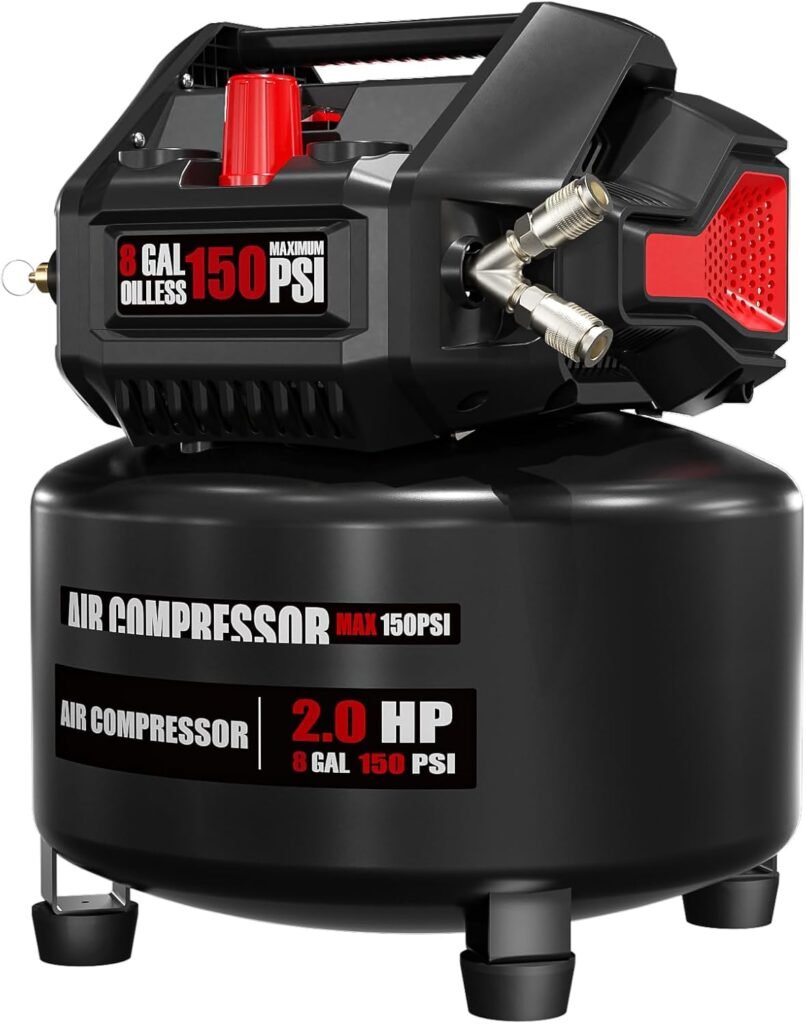

What Makes This Portable Air Compressor Stand Out?
When we look at the “Portable Air compressor, 8Gallon Oil Free Air Compressor Tank, 2HP Motor, Max 150PSI, 2.8SCFM@90 PSI,3.8SCFM@40PSl Garage Air Compressor for Car Repair, Spray Painting, Woodwork Nailing,” we are clearly dealing with a tool that aims to balance power, portability, and ease of use. This is not an industrial behemoth, but it is definitely more than a toy for occasional tire inflations.
We can think of it as a solid middle-ground solution for a home garage, small workshop, or mobile job site where we need dependable air power without committing to a huge stationary unit.
Key Specifications at a Glance
Before we talk about real-world use, it helps to see the basics in one place. We often find that understanding the numbers makes it easier to match a compressor to our actual needs.
Here is a breakdown of the main specs and what they mean for us:
| Feature | Specification | What It Means for Us |
|---|---|---|
| Tank Capacity | 8 Gallons | Enough stored air for short to medium bursts of tool use or multiple inflations. |
| Motor Power | 2 HP | Strong motor for faster recovery and more demanding air tools. |
| Max Pressure | 150 PSI | High enough for most garage, DIY, and light professional tasks. |
| Air Delivery @ 90 PSI | 2.8 SCFM | Suitable for many common air tools that operate around 90 PSI. |
| Air Delivery @ 40 PSI | 3.8 SCFM | Helpful for tasks like light spraying or tools that run at lower pressure. |
| Power Supply | 120V, 60Hz | Standard household voltage in most North American homes and workshops. |
| Pump Type | Oil-free | Less maintenance, cleaner air, and no oil checks or changes. |
| Portability | Portable 8-gallon tank, compact design | Easier to move around garage, job site, or between locations. |
| Safety Features | Overpressure safety valve, thermal protection | Additional protection against overpressure and motor overheating. |
This table gives us a snapshot of what we are working with: a portable, 8-gallon, 2 HP, oil-free unit that runs off standard 120V power and is designed for a blend of convenience and capability.
Performance and Power: How Strong Is It Really?
Motor Strength and Recovery Time
A 2 HP motor in an 8-gallon unit is a meaningful combination for home and light professional tasks. We are not looking at a tiny consumer-grade inflator here; this is a proper shop-style compressor scaled for portability.
The 2 HP rating tells us:
- It can bring the tank up to 150 PSI relatively quickly.
- It should recover faster between tool cycles than a smaller 1–1.5 HP unit.
- It is more capable of handling tools that require sustained air, within reason.
We still need to remember that 8 gallons is a modest tank size. For very air-hungry tools that run continuously, the motor will cycle often. However, for intermittent work—short bursts with nailers, inflating, or occasional tool use—the power-to-tank balance works well.
Air Delivery: 2.8 SCFM @ 90 PSI and 3.8 SCFM @ 40 PSI
The real performance story is in the SCFM numbers:
-
2.8 SCFM @ 90 PSI
This is the working range for many common air tools such as impact wrenches, ratchets, nail guns, and some light pneumatic tools. It is not meant for heavy continuous-duty industrial tools, but for garage and DIY tasks, it is quite usable. -
3.8 SCFM @ 40 PSI
The 40 PSI rating is useful for lighter tools and some spray guns that operate at lower pressures. While serious professional spray rigs may demand higher sustained SCFM, this level is enough for basic spray painting needs on small projects, touch-ups, or hobby work.
In practice, we should see this compressor comfortably handle:
- Inflating car, bike, and trailer tires
- Air blow-off and dust cleaning
- Nailing and stapling in woodwork
- Light to moderate automotive work using compatible tools
- Occasional spray painting of small surfaces or hobby projects
Tank Size and Capacity: Is 8 Gallons Enough?
Balancing Portability and Volume
An 8-gallon tank sits nicely between small hot-dog or pancake compressors (often 1–6 gallons) and larger 20–30 gallon shop tanks. For us, that translates to:
- More stored air than tiny models—less time waiting for refills.
- Lighter weight and easier movement than large, bulky shop units.
- Enough capacity to run short bursts of tools without the motor constantly running.
We should see good performance for tasks that require intermittent airflow. For example:
- Using a brad nailer in woodworking: plenty of quick bursts with minimal downtime.
- Filling car tires: several full tire top-ups from one full tank.
- Short spray jobs: we can manage smaller panels or projects before recovery cycles.
Practical Expectations for Different Jobs
If we are planning:
-
Car maintenance:
Great for tire inflations, blowing out filters, powering an impact for lug nuts (on a limited, intermittent basis), and using an air ratchet occasionally. -
Woodworking:
Very well suited to brad nailers, finish nailers, and staplers. For framing nailers, it can work but we need to be mindful of frequent firing and recovery times. -
Spray painting:
Ideal for smaller-scale work—panels, furniture, small projects—especially when we allow occasional breaks for the compressor to catch up. For large, continuous-spray jobs such as entire vehicles or big walls, a larger, higher-SCFM machine is more appropriate.
We just need to align our expectations with the tank size and SCFM. For hobbyists and regular home users, the 8-gallon capacity hits a comfortable sweet spot.

Portability and Design: How Easy Is It to Move and Use?
Compact Size for Garages and Workshops
This compressor is designed to be portable, and the 8-gallon tank keeps the footprint reasonable. We are not dealing with a massive vertical tank that dominates an entire corner of the garage.
The compact construction makes it well-suited if we:
- Share our garage space with vehicles and storage
- Need a unit we can slide against the wall when not in use
- Want something that can move between rooms or out into the driveway
Because it runs on standard 120V 60Hz power, we can plug it into most household or workshop outlets without special wiring. That adds a lot of flexibility in where we can use it.
Maneuverability Around the Job Site
Portability is not only about size; it is also about how practical it is to move the unit. With 8 gallons of air capacity and a decent 2 HP motor, we can expect a fairly manageable weight—heavier than tiny inflators, but much easier to move than a full-size shop compressor.
For day-to-day use, this makes it convenient when we:
- Need to move it from one bay or work area to another
- Roll it out to the driveway for tire work or cleaning
- Bring it to a small job site or another property when we do repairs
We may still want to avoid carrying it up and down multiple flights of stairs regularly, but for ground-level mobility, this design is practical.
Oil-Free Pump: Maintenance and Convenience
Why Oil-Free Matters
The oil-free design is one of the bigger advantages for casual users and even many professionals. With an oil-free pump:
- We do not have to change compressor oil.
- There is no risk of oil carryover into our air stream.
- We reduce maintenance time and effort.
- We have cleaner air for tools, especially for tasks such as painting or finishing.
For those of us who do not want to add “compressor oil checks” to our maintenance list, this is a real benefit. We basically plug it in, drain the tank periodically, and it is ready to go.
Trade-Offs of Oil-Free Compressors
Every design has pros and cons. Oil-free units are convenient, but we should be aware that:
- They can be slightly louder than some oiled units, depending on design.
- They are often designed for light to moderate duty cycles rather than nonstop industrial operation.
For the use case this compressor targets—garages, home workshops, car repair, woodworking, and small painting projects—the oil-free choice is very practical. We gain hassle-free operation in exchange for not trying to run heavy industrial tools all day long.
Pressure and Control: Working Up to 150 PSI
High Maximum Pressure for Versatility
The maximum pressure rating of 150 PSI gives us some useful overhead. Many common tasks and tools operate around 90 PSI, but having 150 PSI available means:
- We can easily inflate high-pressure tires or equipment.
- The tank holds more usable air between cycles at lower working pressures.
- We have room to adjust down with regulators while maintaining enough stored reserve.
We are not forced to run the compressor right at its limit for most jobs; instead, we typically run tools at a set pressure below the maximum, supported by the tank’s higher ceiling.
Precision Air Pressure Control
The advertised air delivery (SCFM ratings) at 40 PSI and 90 PSI suggests that this unit is designed with controlled working pressures in mind. In normal use, we:
- Set our regulator to match tool requirements (for example, 70–90 PSI for many nailers).
- Let the compressor auto-cycle between cut-in and cut-out pressures (for example, starting up when tank pressure drops, stopping at around 150 PSI).
- Benefit from consistent performance, as long as we are not demanding more SCFM than the compressor can provide continuously.
For tasks such as spray painting or running sensitive tools, precise pressure adjustment and steady supply matter a lot. While this compressor is not a high-end paint booth machine, the rated outputs offer enough control for smaller, careful projects.
Durability and Build Quality
Sturdy Tank and Motor Construction
The description emphasizes durable construction and a sturdy 8-gallon tank. We are not given the exact gauge of the steel, but we can reasonably expect:
- A welded steel tank built to handle up to 150 PSI safely.
- Components selected to withstand normal daily garage and workshop use.
- A motor sized for the job rather than a tiny unit pushed beyond its comfort zone.
The 2 HP motor rating, combined with the safety features, suggests the manufacturer expects this compressor to be used regularly, not just a few times a year.
Designed for Daily Use and DIY Work
The language around “professional tradesperson or DIY enthusiast” signals an intention for this compressor to appeal to both serious hobbyists and working technicians. In our experience, that usually means:
- It will handle daily or weekly tasks without feeling overstressed.
- It is not designed for continuous 8-hour industrial factory shifts, but rather for intermittent use during a workday.
- It should hold up well if we treat it responsibly—proper power source, correct pressure settings, and basic maintenance.
We get a good mix of durability and practicality suited for a busy garage or workshop.
Safety Features: Protection for Us and the Compressor
Overpressure Safety Valve
The overpressure safety valve is a critical feature on any compressor. This valve:
- Automatically releases air if the tank pressure exceeds a safe threshold.
- Helps protect the tank and components from damage due to over-pressurization.
- Provides an extra layer of safety if a pressure switch or control system were to fail.
We do not have to interact with this valve during normal use; it is a passive safeguard working in the background. Knowing it is there adds a layer of confidence when we are running at higher pressures.
Thermal Overload Protection on the Motor
Thermal overload protection helps prevent the motor from overheating. This:
- Shuts the motor down if it gets too hot.
- Reduces the risk of motor damage from excessive usage or poor ventilation.
- Helps extend the overall life of the compressor.
We still need to avoid pushing the compressor beyond its intended duty cycle—for example, we should not run it constantly without breaks in high-temperature conditions. But this feature gives some forgiveness if we occasionally work it hard.
Safe Operation and Maintenance Practices
The product details stress following the user manual, and that is very important. To keep the compressor safe and reliable, we should:
- Use it on the recommended power supply (120V 60Hz with adequate amperage).
- Avoid using long, thin extension cords that can starve the motor.
- Drain condensation from the tank regularly to prevent rust.
- Not exceed recommended duty cycles for continuous operation.
- Ensure proper ventilation so the motor and pump can cool adequately.
These steps are not unique to this compressor, but following them will help us get maximum life and safe performance.
Ease of Use and Everyday Convenience
Setup and Operation
In everyday use, this compressor should feel straightforward:
- We place it on a stable, level surface.
- We plug it into a standard 120V outlet.
- We connect a quality air hose and our chosen tool.
- We power it on, allow it to build pressure, then set the regulator to the desired PSI.
- We start working, letting the compressor cycle as needed.
Because the pump is oil-free, we do not need to perform pre-use oil checks or schedule oil changes. That alone reduces the mental overhead of ownership.
Maintenance Routine
The maintenance routine is simplified but still important. Over time, we should:
- Drain the tank after use or at least regularly to remove moisture.
- Periodically inspect hoses and fittings for leaks.
- Check that safety valves and gauges appear to be working correctly.
- Keep the compressor in a relatively clean, dry area to avoid corrosion and dust buildup.
If we follow these steps, we can expect more reliable operation and a longer service life.
Real-World Applications: How It Fits Our Work
For Car Repair and Garage Work
For our car repair needs, this compressor has a lot going for it:
-
Tire inflation:
With 150 PSI max, it will handle standard car, SUV, and light truck tires easily. We can keep our tire pressures correct without driving to a gas station. -
Light pneumatic tools:
Tools such as 3/8″ air ratchets, small impact wrenches, and blow guns fall within the capability zone, especially when used intermittently. For high-torque, continuous heavy work, we would step up to a larger unit, but for routine tasks, this is enough. -
Cleaning and maintenance:
Blowing out filters, cleaning parts, or drying components after washing becomes much easier with a reliable source of compressed air on hand.
If we are managing a home garage or small shop, this compressor can meaningfully upgrade our workflow.
For Spray Painting and Finishing
The specs specifically mention spray painting, which is a thoughtful use case:
-
For smaller projects like furniture, small auto parts, or hobby work:
- The 3.8 SCFM @ 40 PSI performance can support many entry-level or moderate air spray guns.
- We need to pace our work, allowing for recovery cycles to keep pressure stable.
-
For large, continuous spray projects:
- We may find the tank and SCFM somewhat limiting if we try to spray huge surfaces non-stop.
- It can still function, but we will have more frequent pauses.
If we are a hobby painter, DIY refinisher, or small-scale project enthusiast, this compressor pairs well with those needs.
For Woodwork Nailing and Carpentry
Woodworkers and carpenters often care more about reliability and responsive cycling than huge air reserves. Here, the compressor shines:
-
Brad nailers and finish nailers:
These tools use relatively little air per shot. The 8-gallon tank and 2 HP motor will have no trouble keeping up with standard trim or furniture assembly work. -
Staplers and small tools:
Again, intermittent bursts are well within what this machine can handle. -
Framing nailers (occasional use):
For occasional framing or construction use, it can work, but if we are firing nails rapidly all day, a larger tank and higher SCFM might be more efficient. For intermittent framing tasks, this compressor can step in.
We gain a stable, portable air source that fits well into a woodworking workflow without taking over half the shop.
Noise Considerations: Working Comfortably
The description mentions “Ultra Quiet Air Compressor” in context, although the exact decibel rating is not provided. Oil-free compressors sometimes have a reputation for being louder, but newer designs have focused heavily on noise reduction.
While we cannot quote an exact dB level, we can anticipate:
- It will be clearly audible, as all compressors are, but not overwhelming for typical garage work.
- We will likely be comfortable working near it in a workshop setting, possibly with light hearing protection if we are particularly sensitive.
- Noise will be significantly more tolerable than older, high-RPM shop compressors that used to be common.
If quiet operation is absolutely critical—for example, if we share walls with neighbors or work in very noise-sensitive environments—we may want to check the specific noise rating from the manufacturer. For most garage users, this unit should be reasonably comfortable to live with.
Who Is This Compressor Best For?
Ideal Users
This 8-gallon, 2 HP, oil-free portable compressor suits a specific group of users especially well:
- Home mechanics and car enthusiasts who want a reliable shop-style compressor.
- DIYers who frequently use nailers, staplers, and basic air tools.
- Hobbyists who do occasional spray painting on a moderate scale.
- Small workshop owners needing a compact yet capable air source.
- Tradespeople who need a portable unit for lighter-duty on-site tasks.
For all of these, the balance of tank size, SCFM, oil-free design, and safety features makes practical sense.
Who Might Want Something Larger or Smaller
This model is not for everyone. Some of us may be better served by a different size:
-
We might want a larger compressor if:
- We run heavy pneumatic tools continuously (for example, sanders, grinders).
- We spray paint large areas very often and need high SCFM.
- We operate a busy professional shop with multiple users and tools simultaneously.
-
We might prefer a smaller compressor if:
- We only occasionally inflate tires or sports equipment.
- We rarely or never use air tools.
- We want something ultra-lightweight and extremely portable for very simple tasks.
In the middle, where many real-world users live, this 8-gallon option fits nicely.
Pros and Cons Summary
To make our decision easier, it helps to summarize the strengths and trade-offs based on the details provided.
Advantages
-
Solid power with 2 HP motor
Faster recovery and more capable performance than small entry-level units. -
Good air delivery for its size
2.8 SCFM @ 90 PSI and 3.8 SCFM @ 40 PSI support many common tools and tasks. -
Portable 8-gallon tank
Strong balance between usable air capacity and compact size. -
Oil-free pump
Low maintenance, no oil changes, and cleaner air for painting and finishing. -
Standard 120V 60Hz power
Use in typical household and workshop outlets without special wiring. -
Safety-focused design
Overpressure safety valve and thermal overload protection help prevent damage and accidents. -
Versatile use cases
Suitable for car repair, spray painting, woodworking, general DIY, and small shop work.
Limitations
-
Not for very high-demand, continuous-duty tools
Large sanders, grinders, or industrial equipment may exceed its comfortable limits. -
Tank size may require patience for big spray jobs
For large, continuous painting tasks, frequent recovery cycles may be needed. -
Portability has a weight trade-off
While portable, it is heavier than tiny pancake compressors; repeated lifting or stair climbing may be tiring.
These trade-offs are typical of an 8-gallon, mid-range compressor, and they help us judge whether this model matches our own needs.
Practical Tips for Getting the Most Out of It
Matching Tools to Compressor Capacity
We get the best performance when we match our tools to what this compressor can comfortably deliver. A few guidelines help:
- Check the SCFM requirement of each tool at its recommended PSI.
- If a tool’s SCFM demand is close to or below:
- 2.8 SCFM @ 90 PSI: expect good performance with typical intermittent use.
- 3.8 SCFM @ 40 PSI: good for low-pressure tools and certain sprayers.
- If a tool’s SCFM is far above those numbers, the compressor can still work, but:
- We will see frequent recovery periods.
- The motor will run more often.
For best results, we should choose tools within or slightly under these SCFM numbers for comfortable use.
Using Hoses and Fittings Wisely
To maintain good performance:
- Use quality, appropriately sized hoses to reduce pressure drop.
- Keep hose runs reasonably short when possible.
- Ensure fittings are tight and leaks are minimized.
- Consider quick-connect fittings for convenience if we change tools often.
Every bit of airflow efficiency helps when we are working within a particular SCFM range.
Caring for the Compressor Over Time
Even though this compressor is low maintenance, we still protect our investment by:
- Draining the tank at the drain valve to remove accumulated moisture.
- Storing the compressor in a dry, sheltered place.
- Checking any air filters or intake screens for dust buildup.
- Listening for unusual sounds that might indicate leaks or mechanical issues.
A few minutes of care now and then can prevent rare but costly failures.
Our Overall Impression
When we put all the aspects together—the 8-gallon tank, 2 HP motor, oil-free design, 150 PSI max pressure, and SCFM ratings—we can see a compressor tailored to the real-world needs of many home and small-shop users.
We end up with:
- Enough power and air capacity for meaningful work.
- Manageable size and portability for a typical garage or job site.
- Low-maintenance operation thanks to the oil-free pump.
- Built-in safety mechanisms that guard both us and the compressor.
- Versatility across car repair, woodworking, light spray painting, and general DIY.
If we are looking for a dependable, portable compressor that steps decisively above tiny hobby inflators but does not require the commitment of a huge stationary unit, this “Portable Air compressor, 8Gallon Oil Free Air Compressor Tank, 2HP Motor, Max 150PSI, 2.8SCFM@90 PSI,3.8SCFM@40PSl Garage Air Compressor for Car Repair, Spray Painting, Woodwork Nailing” offers a well-balanced and user-friendly option for our workshop or garage.

Disclosure: As an Amazon Associate, I earn from qualifying purchases.