Have we ever found ourselves on a job site wishing we had more air power, more mobility, and less hassle with cords and electrical hookups?

What Is the 6.5HP Gas Powered Air Compressor and Who Is It For?
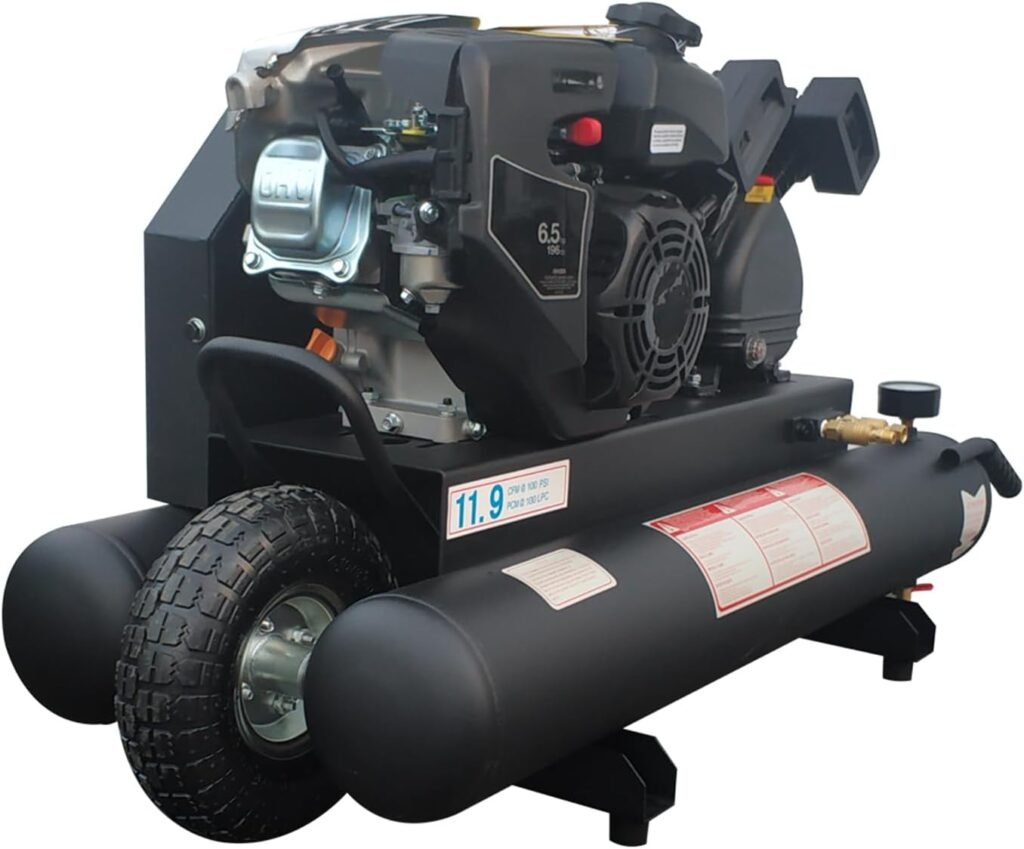
When we look at the 6.5HP Gas Powered Air Compressor 12CFM Portable Gasoline Driven Piston Pump Air Compressed System with a 125 PSI max pressure and 9-gallon air tank, we are clearly looking at a unit built for serious work. This is not a small garage gadget; it is a robust, gas-powered, wheelbarrow-style compressor designed for demanding environments.
We see this unit as a strong match for contractors, workshop owners, farm and ranch operations, and anyone who needs reliable compressed air away from electrical outlets. Because it can be mounted on a truck or service vehicle, it also suits mobile mechanics and on-the-go maintenance crews.
Key Specifications at a Glance
To get our bearings quickly, we like to see how the most important specs line up. These numbers tell us a lot about how the compressor will behave on the job.
| Feature | Specification |
|---|---|
| Power Output | 6.5 HP (gasoline engine) |
| Tank Capacity | 9 gallons |
| Max Working Pressure | 125 PSI |
| Air Flow Rate | 12 CFM |
| Pump Speed | 880 rpm |
| Output Pipe | NPT 1/4″ x 2 |
| Drive Type | Gasoline driven piston pump |
| Certification | EPA Certificate No.: RKHXS.1961GA-036 |
| Construction Materials | Cast iron frame, cast cylinder sleeves |
| Mounting Options | Wheelbarrow style; can be mounted on truck/service rig |
We find that this spec set positions the compressor in a very useful middle ground: powerful enough for many professional tasks, but still portable and manageable for one or two people to move or mount.
Build Quality and Design
The first thing we notice about this compressor is its focus on durability and field use. The key design choices reveal that it was created with rough environments in mind rather than gentle shop corners.
Cast Iron Frame and Pump Components
The compressor features a cast iron frame and cast cylinder sleeves in the pump head. Cast iron is a smart choice for industrial gear: it resists wear, handles heat cycles well, and tolerates the inevitable bumps and vibration that come with daily use.
We appreciate this because it signals that the manufacturer expected this unit to be used hard and often, not occasionally rolled out for weekend DIY only. The cast cylinder sleeves help keep compression efficient over time and reduce internal wear, which means we should see fewer performance drops as the machine ages.
Wheelbarrow-Style Portability
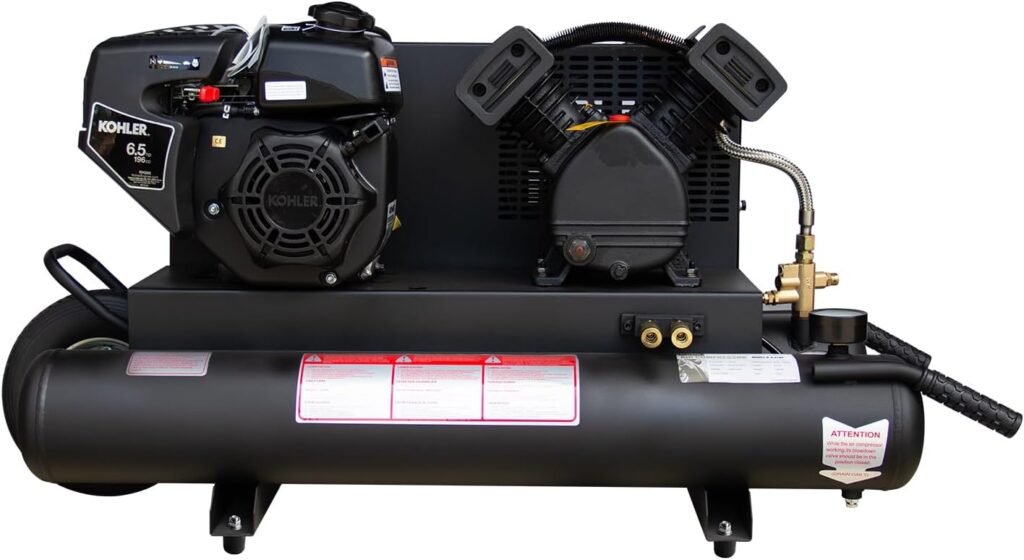
The wheelbarrow-style layout makes a lot of sense for a gas-powered compressor. Rather than a bulky, stationary form factor, this design lets us move the unit around construction sites, yards, or large shop spaces with minimal effort.
We like this layout because:
- It keeps the center of gravity low, improving stability on uneven ground.
- It makes loading into a truck easier when one person lifts from the rear.
- It suits mobile work where we might need to reposition frequently.
Mountable on Trucks and Service Vehicles
A major strength is the compressor’s mountable design. It’s intended to be bolted down or secured in a truck bed, trailer, or service vehicle, turning our rig into a rolling air station.
We see this as especially beneficial if we:
- Run a mobile repair or installation business.
- Maintain large properties, agricultural operations, or fleets.
- Need compressed air at remote job sites where power is unavailable.
In short, the physical design is clearly oriented toward mobility plus toughness, which is exactly what many professionals need.
Power and Performance
When we choose a compressor, power and airflow determine what tools we can realistically run and how quickly we can get work done.
6.5 HP Gasoline Engine
The 6.5 HP gas engine provides the muscle to run the pump and maintain consistent pressure. Unlike electric units, we are free from worrying about outlet availability, extension cord length, or generator capacity (unless we’re powering other tools alongside it).
We like that this power level is enough to support demanding air tools while still being manageable in size and fuel use. It strikes a practical balance between raw output and portability.
12 CFM Airflow and 125 PSI Max Pressure
With 12 CFM (cubic feet per minute) and a maximum working pressure of 125 PSI, we are looking at solid mid-range performance, suitable for many professional air tools. For perspective:
- Most framing nailers, roofing nailers, and brad nailers typically need 2–5 CFM at 70–120 PSI.
- Impact wrenches can need from 4–8 CFM, depending on size and usage pattern.
- Basic spray guns and air ratchets often fall within the 4–8 CFM stripe as well.
This means that, for intermittent use, we can support multiple small guns or one higher-demand tool without the compressor constantly struggling. The 125 PSI rating also aligns well with most job site tools and pneumatic systems.
We do want to note that for very high-demand continuous operations (like sandblasting or multiple large tools running nonstop), we might need a larger CFM rating. But for typical construction, maintenance, and shop work, 12 CFM is a versatile sweet spot.
Pump Speed: 880 RPM
The pump’s 880 rpm speed is relatively modest compared to some high-speed consumer units, and this is a good thing. Lower pump speeds typically mean:
- Less wear over time.
- Lower operating temperature.
- Potentially lower noise compared to ultra-high-speed pumps.
We appreciate the way this contributes to long-term reliability and smoother operation, especially when paired with the cast iron components.
Ease of Operation
When we use a compressor daily, ease of use matters as much as raw power. This unit integrates several features that make operation more straightforward and intuitive.
Automatic Start/Stop Pressure Switch
One of the most useful components is the automatic start/stop pressure switch. Instead of us constantly monitoring tank pressure and manual controls, the unit starts and stops based on preset pressure levels.
We benefit from:
- Consistent pressure without micromanagement.
- Reduced risk of over-pressurizing the system.
- Better fuel and engine efficiency, since it doesn’t run nonstop when not needed.
Manual On/Off Lever
In addition to the automatic pressure switch function, we have a manual on/off lever. This gives us direct control when we want to shut down the compressor, perform maintenance, or prevent any accidental restarts.
We like this combination because it blends automation with control. We can let the system manage routine cycling but still override it instantly if the situation calls for it.
High-Efficiency Finger Valves
The mention of high-efficiency finger valves is important. These valves are designed for:
- Improved airflow and efficiency.
- Easier access for maintenance and replacement.
- Reduced pressure losses inside the pump.
Because they are easy to operate and service, we can keep the compressor functioning at its best without complicated teardown work.
Maintenance and Longevity
A powerful compressor is only as useful as its ability to remain reliable over many years of operation. The design of this unit takes that seriously.
Durable Materials for Demanding Environments
The cast iron construction and cast cylinder sleeves are central to its durability. In heavy-duty industrial or construction environments, compressors are frequently:
- Exposed to dust, debris, and weather.
- Subjected to vibration and occasional rough handling.
- Expected to run for long hours at a time.
We value that this compressor is built with materials that tolerate those conditions. Cast iron’s heat resistance and wear characteristics mean we can rely on the pump to maintain performance under regular heavy use.
Easy Maintenance Design
The compressor is described as easy to maintain, which typically includes:
- Accessible drain valves for tank moisture removal.
- Straightforward access to filters and valves.
- Simple oil checks and oil changes if it’s an oil-lubricated pump.
We appreciate how this translates to reduced downtime. When maintenance can be done quickly and without complex tools, we are more likely to stay on top of it, which in turn extends the lifespan of the compressor.

Portability and Mounting Options
Portability is a defining advantage of this gas-powered system, and the unit offers more than one way to manage it.
Wheelbarrow Mobility
The wheelbarrow configuration makes movement around ground-level job sites fast and manageable for one person in many situations. By lifting the handles and rolling on the wheel(s), we can position the compressor close to where tools are in use.
We find this especially helpful on:
- Construction sites where work zones shift throughout the day.
- Large workshops with multiple bays.
- Outdoor farm or ranch properties.
While heavier than small electric compressors, this format keeps things practical for frequent repositioning.
Truck and Service Vehicle Mounting
The compressor’s design makes it suitable for permanent or semi-permanent mounting in a truck or on a service vehicle. Once mounted:
- We turn our vehicle into a mobile compressed air station.
- We reduce the need to load and unload the compressor daily.
- We retain the ability to work in locations without grid power.
We see this as a major benefit for:
- Mobile mechanics and tire service crews.
- On-site mechanical maintenance teams.
- Construction supervisors who move between multiple projects.
The combination of wheelbarrow mobility and mountable design means we can tailor the setup to the way we actually work.
Safety Considerations
When dealing with high-pressure air systems and gas engines, safety naturally becomes a priority. This compressor includes design features that support safe operation.
Automatic Pressure Control
The start/stop pressure switch is a vital safeguard. It keeps pressure within a predetermined range and stops the compressor from building pressure endlessly if a valve stays closed.
We appreciate that this reduces the chance of:
- Overpressure-related component failures.
- Unsafe tank pressures in unattended use.
- Excess strain on hoses and fittings.
EPA-Certified Engine
The EPA Certificate No. RKHXS.1961GA-036 indicates that the gasoline engine meets specific emissions and environmental standards. While this is not a safety feature in the traditional sense, it gives us confidence that:
- The engine is built to regulated quality standards.
- Emissions are within approved limits, which is better for outdoor work environments.
If we frequently use the compressor around other workers or in moderately populated areas, having an EPA-certified engine is a plus for health and regulatory reasons.
General Operating Safety
While not explicitly listed, we would always operate a gas-powered compressor with basic precautions:
- Use in well-ventilated outdoor or semi-open spaces.
- Ensure hoses and fittings are rated for 125 PSI or higher.
- Wear hearing protection if noise levels are significant.
- Follow proper startup, shutdown, and fueling procedures.
The product’s built-in safety aids, combined with good practices from us, create a safer work setup overall.
Typical Applications and Use Cases
This compressor is described as suitable for a wide range of applications, which is one of its standout strengths. Let’s look at some typical sectors and how this unit fits in.
Construction and Job Sites
In construction, we regularly need:
- Nail guns (framing, roofing, finishing).
- Impact tools for fastener removal and installation.
- Air for cleaning equipment and surfaces.
The 12 CFM at 125 PSI output is well aligned with these tasks. Since the unit is gas-powered, we don’t rely on site power or worry about tripping breakers. We can move between different parts of a site and keep tools running consistently.
Workshops and Machinery Maintenance
In workshops and for general machinery maintenance, we might use:
- Air ratchets and impact wrenches for equipment repair.
- Air blow guns for cleaning debris from parts.
- Light spray painting or coating (depending on the specific requirements).
The 9-gallon tank provides a decent air reserve for intermittent bursts, while the engine keeps refilling the tank as we work. For stationary workshop use, mounting it permanently or semi-permanently and adding hose reels can create a robust shop air solution without needing high-amperage electrical service.
Industrial and Commercial Sectors
The product description mentions several sectors:
- Chemical industry
- Light industry
- Textile
- Food processing
- Health
- Electronics
- Machinery
- Mining
- Construction
- Scientific research
While we would always align use with any specific cleanliness or contamination requirements (for example, food or health sectors may demand special filtration and oil-free air), the core compressed air output is suitable for a broad range of industrial and commercial tool sets.
We particularly appreciate that the compressor can function wherever we can get the unit and fuel to the site, which helps in remote mining, agricultural, and infrastructure projects.
Performance in Real-World Use
Technical specs are important, but how the compressor feels in real-world daily use is what truly matters.
Startup and Runtime Behavior
With an automatic pressure switch and a 6.5 HP engine, we can expect that:
- The unit starts up, builds tank pressure, and then idles off or stops at the set pressure.
- As we draw air and tank pressure falls, it will restart to maintain working pressure.
We appreciate that we don’t have to babysit the system. Once it’s fueled, connected, and started correctly, it should manage its own cycles while we focus on the task.
Tool Compatibility
Given the 12 CFM rating, we see comfortable compatibility with:
- Framing and roofing nailers.
- Flooring nailers and staplers.
- Air ratchets and small to medium impact wrenches.
- Blow guns and tire inflators.
- Some HVLP spray guns (checking their specific CFM requirements first).
For tools that require very high continuous CFM (e.g., large sandblasters, continuous industrial polishing wheels), we would either scale up to a larger compressor or adjust our usage pattern. But for general contractor and maintenance tasks, this rating is more than adequate.
Field Reliability and Durability
The cast iron construction and slow pump speed keep us confident about long-term durability. As long as we:
- Keep up with oil changes (if applicable).
- Drain the tank to remove condensation.
- Check and replace filters and valves as recommended.
We should get years of service life from the pump and frame, even under tough conditions. For those of us working on rough terrain or in harsh weather, this kind of durability is invaluable.
Pros and Cons Summary
We always find it helpful to pull everything together into a clear pros and cons perspective before deciding whether a product fits our needs.
Strengths We Appreciate
- True portability thanks to gas power and wheelbarrow/mountable design.
- 6.5 HP engine and 12 CFM output suitable for many professional tools.
- 125 PSI max pressure, matching common pneumatic tool requirements.
- Cast iron frame and cast cylinder sleeves for long-term durability.
- Automatic start/stop pressure switch with manual lever for safer, simpler operation.
- High-efficiency finger valves, easier to service and maintain.
- Designed to be mounted in trucks or service vehicles, ideal for mobile work.
- Broad application range from construction to industrial sectors.
- EPA-certified engine, demonstrating compliance with emissions standards.
Limitations to Keep in Mind
- As a gas-powered unit, it is not suited to indoor use without strong ventilation.
- Noise levels are likely higher than small electric compressors (common to gas units).
- The 9-gallon tank is adequate, but very air-intensive, continuous tasks might seek a larger tank or higher CFM.
- Requires regular fueling and engine maintenance, which we avoid with electric models.
We see these not so much as flaws but as trade-offs inherent to the design. If we need mobility and power without reliance on electricity, these trade-offs are normally well worth it.
How This Compressor Compares to Electric Units
When we are choosing between gas and electric compressors, it helps to think in terms of where and how we work rather than simply specs on paper.
-
Gas Advantages:
- No need for electrical outlets or generators.
- Ideal for remote or outdoor job sites.
- Generally higher portability for heavy-duty work.
-
Electric Advantages:
- Quieter operation.
- No fuel to manage; often easier for indoor use.
- Less day-to-day engine maintenance.
This 6.5HP Gas Powered Air Compressor clearly stakes its ground on the gas side. If we primarily work indoors in a fixed location with reliable power, an electric compressor might be more convenient. However, if our work is mobile or remote, this unit makes far more sense.
Who Will Get the Most Value From This Compressor?
To decide whether this is the right compressor for us, we can consider how closely our typical day matches the situations this machine was designed for.
We will likely get strong value if:
- We run a construction, roofing, framing, or siding crew that frequently moves between sites.
- We are mobile mechanics or service technicians needing reliable compressed air on the road.
- We manage farms, ranches, or remote facilities with intermittent or no power access.
- We want a durable, long-term compressor that can withstand rough environments and daily use.
- We prefer one compressor that can serve both workshop and field duties, thanks to its mountable design.
If, on the other hand, we mostly work in one place with stable access to electricity and want quieter operation with no fuel, an electric model may still be our best choice. It really comes down to whether portability and independence from power outlets are primary priorities.
Practical Tips for Getting the Most Out of This Compressor
To maximize the value and lifespan of this compressor, we can follow a few practical approaches in daily use.
Setup and First Use
- Secure placement: When operating on the ground or truck-mounted, ensure the unit is stable and cannot roll or tip.
- Check oil levels (if oil-lubricated) and top up with the recommended type before first startup.
- Inspect all fittings and hoses to ensure they are tightened and rated for at least 125 PSI.
- Run the compressor initially without tools connected to verify correct pressure cycling and to check for leaks.
Routine Maintenance Habits
- Drain the tank regularly to prevent internal rust from condensation.
- Change engine oil and pump oil according to the manual’s schedule.
- Inspect and clean air filters to maintain good airflow and protect internal components.
- Check belts, valves, and hoses for signs of wear and replace as needed.
We find that building these habits into our workflow pays us back with fewer unexpected breakdowns and more consistent performance.
Safe Operation Practices
- Always operate the compressor in well-ventilated spaces due to engine exhaust.
- Wear hearing protection if using it for extended periods.
- Avoid exceeding the rated PSI of hoses, tools, and accessories.
- Use proper fuel storage and handling to prevent spills and fire hazards.
Following these practices lets us tap the full potential of the compressor without compromising safety.
SEO-Focused Recap: Why This 6.5HP Gas Powered Air Compressor Stands Out
For anyone searching for a portable gas-powered air compressor with robust capabilities, this 6.5HP Gas Powered Air Compressor 12CFM Portable Gasoline Driven Piston Pump Air Compressed System stands out due to a mix of power, mobility, and durability.
We get:
- 6.5 HP of gas power, delivering 12 CFM at up to 125 PSI, ideal for a broad range of job site tools.
- A 9-gallon air tank that balances capacity with manageable size.
- Rugged cast iron frame and cast cylinder sleeves, built for demanding environments.
- Wheelbarrow-style portability plus truck/service-vehicle mounting, giving us flexible deployment options.
- Automatic start/stop pressure control for easier operation and improved safety.
- Broad usefulness across construction, workshops, machinery maintenance, and industrial sectors.
If our work demands reliable compressed air away from traditional power sources, and we need a unit that can handle daily, heavy-duty use, this compressor offers a compelling combination of features and long-term value.
In our view, for crews and professionals who live and work on the move, this 6.5HP gas-powered compressor is much more than just another tool; it becomes a core part of how we keep our projects and repairs moving efficiently, wherever the job takes us.

Disclosure: As an Amazon Associate, I earn from qualifying purchases.